
North Yorkshire surveyors
RICS Chartered Surveyors in Skipton
Skipton is the last proper town before the Dales, and the property market reflects exactly that position. In the town itself there are Georgian and early Victorian houses off the High Street and around the church and castle, long stone terraces at Gargrave Road, Broughton Road and the Bailey, canal side cottages and warehouses converted to flats along the Springs Branch, and estates of the 1960s onwards spreading out towards Carleton and Embsay. Step a mile beyond that and the stock changes entirely into farmhouses, field barns, gamekeepers' cottages, mill hamlets and the odd substantial house standing on its own with its own water, its own drainage and its own weather.
A Level 3 Building Survey in Skipton examines the structure in detail, explains what is causing each defect and puts the repairs in order of priority. It suits Craven barn conversions, limestone and gritstone cottages and rural homes with private drainage, and the surveyor attends within 3 to 5 working days of instruction.
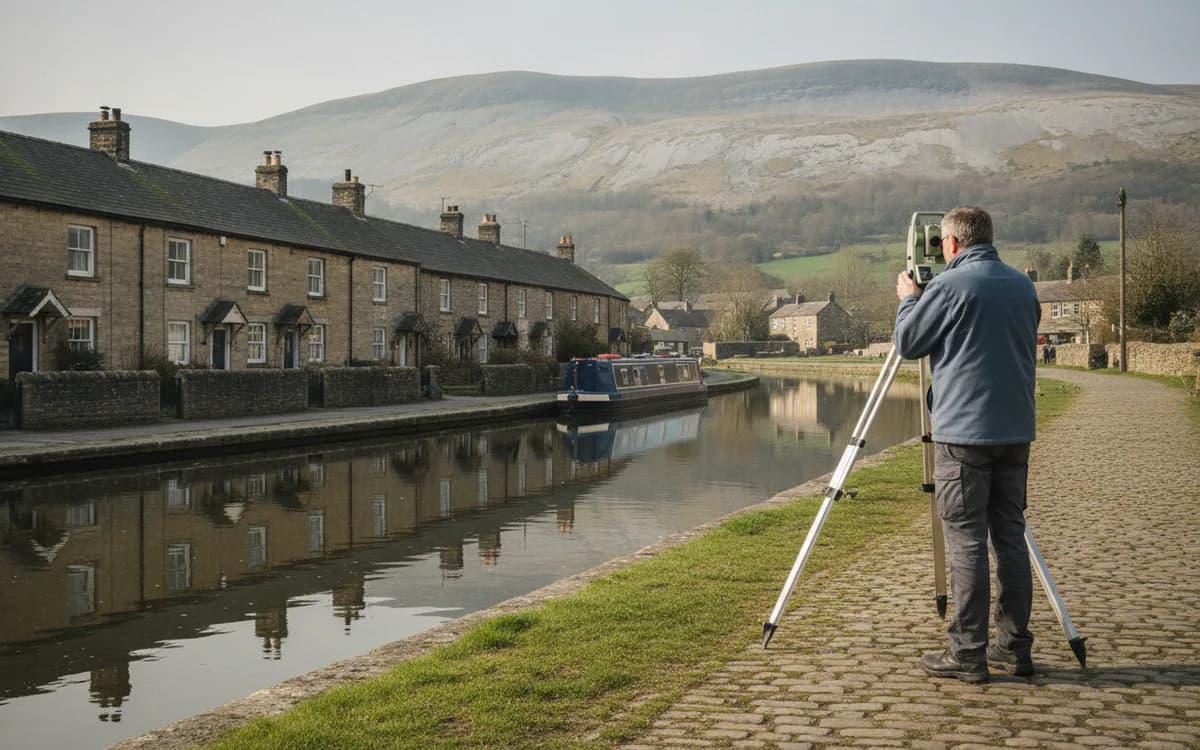
Surveying property in Skipton
The survey level question is decided by that second category more often than the first. A 1970s detached house at Carleton is ordinary work for a Level 2 Homebuyer Survey. A seventeenth century farmhouse at Cononley, or a barn at Embsay converted twenty years ago by somebody's brother in law, is not: the walls are rubble, the floors are whatever the ground allowed, the drainage runs to a tank in a field and the building has been adapted by every owner it has had. That is a Level 3 Building Survey, and instructing anything less on it wastes the fee.
The surveyor who inspects the property is the person who writes your report and takes your call about it, which matters more in Craven than in a town, because half of what you need to know about a rural property comes out of a conversation. Fees are fixed and confirmed in writing before you commit. We aim to be at the property within 3 to 5 working days of instruction and to send the report within 3 to 5 working days of the visit, with 24 hour attendance available on request when a chain demands it.
The survey most often needed here
Level 3 Building Survey in Skipton
A Level 3 Building Survey (formerly the full structural survey) is the most thorough RICS inspection. It suits period homes, listed buildings, timber-framed and non-standard construction, properties that have been extended or altered, and anything in poor condition. The surveyor examines the structure and fabric in detail, explains the likely cause of any defect, sets out repair options and priorities, and discusses the findings with you before and after the inspection.
Suits Buyers of pre-1900 or period property, listed and conservation-area homes, extended or converted houses, non-standard construction, or any property showing signs of movement, damp or neglect.
Craven ground: limestone, faults, sinkholes and radon
Skipton sits on one of the most abrupt geological boundaries in England. The Craven Faults run across the district, and they separate the massive Carboniferous limestone of the Dales to the north from the shales, sandstones and thinner limestones to the south. The consequence for a buyer is that two houses a few miles apart can be standing on ground that behaves in completely different ways, and neither the estate agent's particulars nor a mortgage valuation will mention it.
Limestone is soluble. Rainwater that has picked up a little acidity dissolves it slowly along joints and bedding planes, opening fissures, then voids, then in places a cave system. Where the soil cover above such a void is thin or is washed down into it, the surface can subside, sometimes gradually and occasionally all at once. Craven is well supplied with the evidence: shake holes pocking the fields, streams that vanish into the ground and reappear somewhere else, and depressions in pasture that follow lines nobody put there. A property does not have to be sitting over a cavern to be affected. Localised settlement over a soft filled hollow does the damage just as effectively, and it shows as cracking that is worse at one corner, a drive that dips year on year and drains that keep breaking in the same spot. Where what we see points that way, the report tells your solicitor to obtain ground stability data for the site rather than leaving you to hope.
Radon deserves proper attention here and rarely gets it. Parts of the Dales and the ground around Craven are designated radon Affected Areas, meaning a measurable proportion of homes exceed the action level for this naturally occurring radioactive gas, which seeps out of the rock and accumulates in enclosed ground floor space. Limestone country with fissured rock beneath it, and the mineralised ground associated with the faults, is precisely the setting where it occurs. The practical points are these. A survey cannot measure radon, because measurement means leaving detectors in the house for three months to average out the seasonal swing. A radon report for the postcode is inexpensive and your solicitor should obtain one. If the property is in an Affected Area and the ground floor has been replaced, or an extension has been built, protective measures should have been incorporated, and where we can see no evidence that they were we say so. Remediation in an existing house is usually a sump and a small fan, which is neither ruinous nor complicated, but it is far better established before exchange than discovered afterwards.
Water is the fourth part of the ground story. The Aire rises above Gargrave and runs down past Skipton towards Cononley, and property on the valley floor at Cononley and along the washlands has taken water in the past, while Eller Beck and the smaller becks through the town itself have surcharged in heavy rainfall. On limestone, groundwater does something extra: it moves through fissures rather than percolating evenly, so a spring can appear in a cellar after a wet week and disappear again. Where the setting calls for it the report asks for a flood search, and in any low lying property we are looking for replaced floors, plaster renewed to a consistent height and skirtings newer than the house around them.
Barns, farmsteads and the services that come with rural property
The converted barn is the signature purchase in Craven and the one that produces the longest reports. A field barn or a farmstead range was built as a single open volume with rubble walls, minimal footings sitting more or less directly on the soil or on rockhead, a roof carried on a handful of heavy trusses, and no requirement whatever to be warm, dry or level. Turning it into a house asks it to be all three. Most conversions here happened between the 1980s and the present, and the quality varies more widely than in any other category of property we inspect.
The structural questions come first. Wide openings were formed in rubble walls to take glazing, and those openings need a lintel with a proper bearing and padstones to spread the load: where that was skimped the stonework above drops and a crack climbs from the corner of the frame. New floors were inserted into a volume never designed to carry them, so we look at how the joists are supported, whether the wall was strengthened or simply drilled, and whether the ridge and purlins have moved since. Original roof trusses were frequently cut about to gain headroom in a mezzanine. Timber lintels and bressumers over former cart and byre openings are often still in place, embedded in damp masonry, and wet rot in a beam like that is not visible until somebody opens up the plaster.
Moisture is the second theme. A rubble wall a metre thick has no damp proof course, and it stayed sound for centuries because it was cold, ventilated and unheated. Insulate it internally, seal the floor, fit tight joinery and heat it, and the moisture that used to leave through the inner face condenses within the construction instead. The joist ends and wall plate sit in the worst of it. Rendering the outside in cement, or coating it in a modern masonry paint, makes matters worse rather than better by closing off the last route out. We take moisture readings, but we read the building first and the meter second, because a meter on a rubble wall tells you what is in the plaster, not what is in the stone.
Then there are the services, which is where rural buyers are most often caught out. A large number of properties around Gargrave, Cononley, Embsay and the villages up Wharfedale and Airedale are not on mains drainage. They run to a septic tank or a package treatment plant, and since the general binding rules changed a septic tank discharging directly to a ditch, beck or river has had to be replaced or upgraded, which is the buyer's problem the moment the deeds change hands. A drainage field needs the right soil and enough space to work, and fissured limestone ground is poor at providing either, since effluent can travel through fissures instead of being treated by the soil. We ask what the system is, where it discharges, when it was last emptied, who else is connected to it and whether any consent or registration exists. Private water supplies from a spring or borehole raise the same style of question: recent sampling, the state of the storage tank, where the pipe runs and whose land it crosses, and whether anything in writing protects your right to it.
Defects we see most in Skipton and Craven homes
The pattern of findings here is rural and geological rather than industrial, and these are the ones that appear most often in our reports.
- Localised settlement over solution features and soft filled hollows in limestone ground, showing as cracking concentrated at one corner, a drive that keeps dipping and drainage runs that fracture repeatedly in the same place.
- Septic tanks still discharging to a beck or ditch contrary to the general binding rules, and drainage fields that are undersized, waterlogged or laid in ground that was never capable of treating the outflow.
- Wide glazed openings formed in rubble barn walls with an inadequate lintel bearing or no padstones, with diagonal cracking running up from the head of the frame.
- Cement render and modern masonry paint applied over limestone and gritstone rubble, sealing the wall so moisture leaves through the internal finish and decays the plaster and skirtings instead.
- Properties in radon Affected Areas where a ground floor slab has been replaced or an extension added with no evidence that protective measures were incorporated.
- Private water supplies with no recent sampling record, untraced pipework crossing land in other ownership and storage tanks that have not been opened for years.
- Decayed timber lintels and bressumers over former cart and byre openings, carrying load while embedded in masonry that has been damp since the roof last leaked.
- Field walls, outbuildings and garden structures built with no real foundation, leaning or bellied, and left out of the maintenance of the house they belong to.
Buying in Craven: planning constraints, access and the right moment to instruct
Skipton draws buyers from the West Yorkshire cities and from further afield, and good property here goes quickly. Instruct the survey once your offer is accepted, before you fix your mortgage product, because on a rural purchase the findings can change the shape of the deal rather than just the price. A drainage system that has to be replaced, a barn conversion needing structural work or a water supply with no documented right attached to it all take time to resolve, and time is what you lose by waiting for the searches first.
Access has to be organised properly on a rural inspection and we arrange it through the agent in advance. On a farmstead we want the outbuildings unlocked, the roof space reachable, the tank lid locatable, the electricity and water isolators identified and somebody able to say where the boundary actually runs, since a stone wall and a title plan do not always agree in this district. Winter weather matters too. A single track lane above Embsay or towards Grassington can be impassable after snow, and a visit booked for a settled week is worth more than one hurried through in bad conditions.
Planning constraint varies sharply across a short distance. Skipton itself lies outside the Yorkshire Dales National Park, but Grassington and much of upper Wharfedale are inside it, where planning control is tighter, permitted development rights are more limited and the expectations for materials and detailing on any alteration are higher. The town has conservation areas covering the historic core and the canal, and listed buildings are numerous, from the castle and the High Street down to farmhouses and barns that carry a listing most owners are surprised by. The report records designation and flags alterations that look as though they required consent nobody can produce.
It is worth being clear about the arithmetic on an older Craven property. The average repair bill facing new home owners is around £5,750, and on a converted barn or an unmodernised farmhouse the sum our reports identify is regularly a multiple of it, because the work comes in indivisible lumps: a roof, a drainage system, a damp strategy, a set of windows. None of that is an argument against buying. It is an argument for knowing the number and the order the work has to be done in, which is what the report sets out.
When the report reaches you, ring the surveyor and talk it through. Where something needs to be quantified we can follow up with a structural engineer's report or a timber and damp report, so you go back to the seller with evidence rather than an anxiety.
Other surveys and valuations we carry out around Skipton
Besides Level 2 and Level 3 surveys, clients in Craven instruct us for structural engineer's reports where a barn conversion or a farmhouse is showing movement, timber and damp reports on rubble walled property and cellared town houses, and drone roof surveys where a long farmstead range or a steep town roof cannot be seen safely from the ground. Valuation work is a substantial part of what we do here: probate valuations, matrimonial valuations, private valuations for sales within a family, Help to Buy valuations and building insurance reinstatement assessments, which matter on stone property because rebuilding in matching materials to a conservation or listing standard costs considerably more than rebuilding in brick and tile.
We cover Gargrave, Embsay, Cononley, Sutton-in-Craven and Grassington from the same base, together with the farms and hamlets in the dales between them, and travel is included in the fixed fee so an isolated address does not attract an extra charge. On the commercial side we survey shops and offices in the town, agricultural buildings, workshops and let units, prepare schedules of condition before a lease begins, advise on dilapidations at the end of one and carry out commercial valuations and rent reviews. The complete list is on our Types of Survey page, and if your situation is not covered there, call and tell us about the property.
Which level do I need
Level 2 or Level 3 for a Skipton home?
The decision in four questions
Which survey level does a Skipton property need?
Read down the left column. If most of your answers sit in the Level 2 column, a Level 2 Homebuyer Survey is usually enough. If two or more sit in the Level 3 column, instruct a Level 3 Building Survey. A valuation on its own only tells you what the property is worth, not what is wrong with it.
| Question | Points to Level 2 | Points to Level 3 |
|---|---|---|
| How old is the property? | Built after about 1900, conventional brick or block construction. | Victorian or older, timber-framed, thatched, listed or in a conservation area. |
| Has it been altered? | Original layout, or a straightforward extension with building control sign-off. | Extended, converted, loft conversion, removed walls, or unknown history of works. |
| What condition does it look in? | Well kept, no obvious cracking, damp or roof problems. | Visible cracking, damp patches, sagging roof, or it has been empty for a while. |
| What do you want from the report? | A clear condition rating on each element and a list of what to check before exchange. | The cause of each defect, repair options, priorities and a discussion with the surveyor. |
Still on the fence? Call 07970 562 963 and describe the property. It takes two minutes and the surveyor will tell you straight which level fits and what it will cost.
Common questions in Skipton
Survey questions from Skipton buyers
Is radon genuinely something to worry about near Skipton?
It is something to check rather than worry about. Parts of Craven and the Dales are designated radon Affected Areas, where a measurable share of homes exceed the action level. Testing is cheap, the result is definitive, and where a level is high the fix is normally a sump and a small extraction fan rather than anything structural.
Can the surveyor measure the radon level while inspecting the house?
No, and anyone who offers to is misleading you. A meaningful measurement means leaving detectors in the property for three months so that seasonal variation averages out. What we do is identify whether the setting and the construction put the property at risk, note whether any protective measures appear to be present, and ask your solicitor to obtain a radon report for the address.
What is a solution feature and should one stop us buying?
It is a void or a softened hollow in limestone created by water dissolving the rock along its joints over a very long period. Most cause no trouble at all. The concern is localised subsidence where soil above one has washed down into it, so the survey looks at the pattern of any cracking, the behaviour of drives and drainage, and recommends ground stability data where it is warranted.
We are buying a converted barn at Embsay. Which survey do we need?
A Level 3 Building Survey, effectively without exception. A barn conversion asks rubble walls with minimal footings to carry loads they were never built for, and the questions that decide whether it is a good buy are how the inserted floor is supported, how the glazed openings are formed and what the internal lining has done to the wall behind it. None of those are Level 2 questions.
Does the survey cover the septic tank?
We inspect what is visible and accessible and we ask the right questions, but a survey is not a drainage test. We establish what the system is, where it discharges, whether it appears compliant with the general binding rules and whether other properties share it, then recommend a drainage inspection where the answers are unclear. An upgrade becomes your liability on completion, so it is worth settling early.
The property has a private water supply from a spring. What should we check?
Four things: recent sampling results, the condition of the collection chamber and storage tank, the route the pipework takes and whether it crosses land belonging to somebody else, and whether a legal right to the supply and to maintain it is documented in the title. The survey covers the physical condition and your solicitor deals with the rights.
Someone has rendered the cottage in cement. Is that a problem here?
Usually yes. Limestone and gritstone rubble walls work by letting moisture move through them and evaporate. A cement render, or a modern masonry paint over it, closes that route, so the moisture leaves through the inside instead and takes the plaster and skirtings with it. The report explains what a breathable repair involves and how urgent it is in that particular case.
How is a fee for a rural Craven property calculated?
Chiefly on the size, age, type and value of the building, and on how much there actually is to inspect, since a farmstead with three outbuildings and its own drainage takes a good deal longer than a town house of the same floor area. The fee is fixed, confirmed in writing before you instruct us, and includes travel to any address in the district.
How quickly can you get a surveyor to Skipton or up into the dales?
We aim to attend within 3 to 5 working days of instruction and to issue the report within 3 to 5 working days of the inspection. Where an exchange date is tight, tell us at the enquiry stage and we can attend within 24 hours on request. In hard winter weather we will discuss access on a remote lane before booking a date.
Is buying inside the Yorkshire Dales National Park different?
The building is inspected in the same way, but the constraints around it are tighter. Skipton itself sits outside the Park while Grassington and much of upper Wharfedale sit inside it, where permitted development is more restricted and materials and detailing on any alteration are closely controlled. The report notes the designation so you know what altering the property later would involve.
What does past flooding at Cononley mean for a purchase there?
It means looking hard at the evidence and at the insurance position. On the Aire valley floor we check for replaced floors, plaster renewed to a consistent height, new skirtings against older walls and any sign of reinstatement work, and we recommend a flood search. We also suggest asking the seller directly about claims history, since that shapes what cover will cost you.
Do you carry out probate and private valuations across Craven?
Yes, throughout Skipton, Gargrave, Embsay, Cononley, Sutton-in-Craven, Grassington and the farms between them. Valuation work is common here because rural estates often include land, barns and cottages alongside the main house. A valuation gives a figure and does not assess condition, so where a family needs both we will explain which combination of reports fits the situation.
Also covered from Skipton
We survey Gargrave, Embsay, Cononley, Sutton-in-Craven and Grassington from our Skipton work, at the same fixed fee. Travel is included, so the figure does not change because the property sits on the edge of the patch.
Book your survey
Book a survey in Skipton
Postcode, survey type and a phone number. The surveyor will come back with a fixed fee for the Skipton property and the earliest date.
Prefer to talk it through first?
Call 07970 562 963