
North Yorkshire surveyors
RICS Chartered Surveyors in Ripon
Ripon is the smallest cathedral city in Yorkshire and it is built almost entirely of pale Magnesian Limestone. Georgian stone houses stand around the Market Square with its obelisk, where the hornblower still sets the watch every evening at nine. Behind them run older yards and lanes, then Victorian and Edwardian villas along the approach roads, inter war and post war housing towards the edges, and beyond that a wide rural district of farmhouses, converted barns and estate cottages running out towards Fountains Abbey, the racecourse and the villages along the Ure.
A probate valuation in Ripon gives executors a formal open market figure for the property at the date of death, written so it can be entered in the inheritance tax account and defended afterwards. In this city it must also account for gypsum ground conditions, which affect insurance and lending.
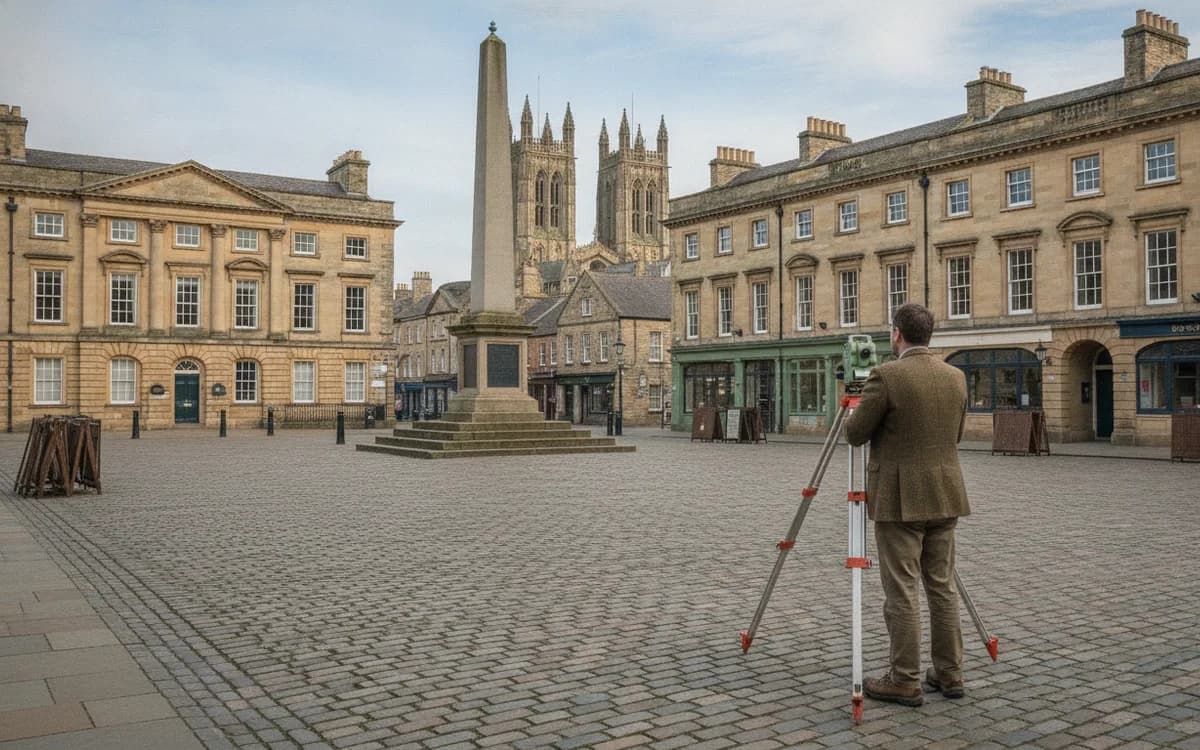
Surveying property in Ripon
Underneath a good part of it lies gypsum. Ripon sits above Permian gypsum beds that dissolve in moving groundwater, and over time that dissolution opens cavities which eventually reach the surface as sinkholes. This is not a curiosity. It is the single most consequential fact about property in this city, it shapes what insurers will cover and what lenders will accept, and it is the first thing we look into on any Ripon instruction, whether the job is a purchase survey or a valuation for an estate.
Much of our work here comes from executors and their solicitors. A probate valuation has to give a defensible open market figure at the date of death, and in Ripon that means pricing the ground conditions honestly rather than ignoring them. We also carry out purchase surveys at both levels, private and matrimonial valuations, and reports on the rural property that makes up so much of the surrounding district. One chartered surveyor inspects, writes and discusses the report with you. The fee is fixed and confirmed in writing before you instruct, attendance is normally within 3 to 5 working days, and the report follows 3 to 5 working days after the visit. Where an estate or a sale is under time pressure, say so and we will work to it.
The survey most often needed here
Probate Valuation in Ripon
Executors and administrators need a valuation of the deceased's property at the date of death to complete the inheritance tax account. A formal RICS probate valuation gives HMRC a defensible figure, reduces the risk of a later challenge, and helps the estate decide whether to sell or retain the property. We handle these sensitively and can liaise with solicitors directly.
Suits Executors, administrators and solicitors administering an estate.
The ground under Ripon: limestone above, gypsum below
The building stone and the problem stone are close relatives. Ripon stands on the Permian outcrop, the same belt of Magnesian Limestone that runs down the eastern edge of the Pennine coalfield, and that limestone is what the city is made of. It is a pale, creamy, dolomitic stone, softer and more absorbent than the gritstone of the western towns, and it needs soft lime mortars and gentle repairs for reasons set out further down this page.
Interleaved with that Permian sequence are beds of gypsum, a calcium sulphate mineral laid down when shallow seas evaporated. Gypsum is far more soluble than limestone. Where groundwater is moving through it, gypsum dissolves at a rate measured in human lifetimes rather than geological ones, and the ground loses volume as it goes. What is left behind is a void in the rock, sometimes small, sometimes large enough to swallow a garden. The overlying material then arches over the cavity until it can no longer bridge it, and at that point the surface drops, often suddenly and often in a near circular hole several metres across.
Ripon is the best documented place in Britain for this. Collapses have opened in gardens, in fields, under roads and under buildings within the district over many decades, including one in 2014 that damaged a house badly enough that part of it had to come down. They are not evenly spread. The affected ground follows a belt running broadly north to south through the district where the gypsum lies at a depth and in conditions that let water move through it, and there are parts of the city where the risk is negligible and parts where it is material. Establishing which side of that line a particular property sits on is the starting point for any instruction here.
The rivers matter too, and not only for flooding. The Skell and the Laver come down through the city to join the Ure, groundwater levels in that valley fluctuate, and moving water is precisely what drives the dissolution. On the flood side, the low ground near the rivers has taken water in the past and a flood alleviation scheme was built in response, so our reports look for the ordinary evidence of past entry, including tide marks in outbuildings, replaced skirtings and floors, and ventilation that has been blocked up rather than repaired.
What the gypsum actually means when you buy, insure or inherit
Start with what a surveyor can and cannot do. No surveyor can see a cavity twenty metres below a lawn. What we can do is read the building. Subsidence of this kind produces a distinctive pattern: cracking that is wider at one end than the other, tapering through the full thickness of the wall rather than only the plaster, distortion of door and window openings, floors falling away towards one corner, and repairs that have been made and then reopened. We record what is there, we say whether the pattern is consistent with ground movement or with something far more ordinary such as thermal movement or a failed lintel, and where it matters we recommend a structural engineer's report before you commit.
The second half of the job is the paperwork, and this is where Ripon differs from every other town on this site. Your solicitor should obtain a ground stability or subsidence search covering dissolution features, not just a standard mining report, because coal mining is not the hazard here. The British Geological Survey publishes hazard data for dissolution and it is the basis of most of those searches. Where development has taken place within the affected belt, the planning authority has for many years expected ground investigation to support it, so there may well be a site investigation report in existence for a newer property, and it is worth asking for.
Insurance is the practical constraint that catches buyers out. Subsidence cover is not guaranteed in this city. Some insurers decline it, some impose a substantially higher excess for subsidence claims specifically, and a property with a claim history can be difficult to move to a new insurer at all. The important point is to establish before exchange that cover is available on terms you can live with, and to find out whether the existing policy can be continued rather than assuming a fresh one can simply be bought. A lender will want to see cover in place, so the insurance question and the mortgage question are really the same question.
For executors the consequence is different but no less real. If a house is in the affected belt, or has a history of movement, or carries an unusual insurance arrangement, the open market value at the date of death reflects that, and a probate valuation which quietly ignores it is not doing its job. We say so in the report and explain the basis, because the executors have to be able to justify the figure later. It cuts both ways: a great many Ripon properties are perfectly ordinary, well outside any area of concern, and it is just as wrong to discount one of those out of vague nervousness about the city's reputation.
Defects we see most in Ripon homes
Alongside the ground conditions, the city's stone and its rural surroundings generate a recognisable set of findings.
- Tapering structural cracking through the full thickness of a wall, with distorted openings and sloping floors, which needs assessing against ground stability information rather than dismissed as settlement.
- Historic repairs to earlier movement that have been decorated over, where the question is whether the movement stopped or merely paused.
- Surface powdering and loss of the hardened outer skin on Magnesian Limestone elevations, accelerated wherever a hard cement mortar or a harder replacement stone has been introduced next to the original.
- Rainwater goods discharging at the base of a wall or into a gully that no longer runs, which concentrates water exactly where soluble ground least needs it.
- Septic tanks and package treatment plants on rural property around the city, frequently undersized, rarely serviced and often discharging in a way that no longer complies.
- Barn and outbuilding conversions with thin or absent insulation, condensation at the wall head and roof structures adapted rather than designed for their new loads.
- Oil storage tanks on unbunded bases close to a watercourse or a boundary, which is a liability question as much as a condition one.
- Damp at low level in the older yards and lanes behind the Market Square, where ground levels have risen and the original stone floors have been sealed with an impermeable screed.
Buying, valuing and administering an estate in Ripon
On a purchase, sequence matters more here than in most places. Instruct the survey as soon as the offer is accepted, and ask your solicitor to order the ground stability search at the same time rather than waiting for the standard search pack to come back in its own time. The two pieces of information answer each other. A clear search alongside a building with no structural concern lets everyone relax quickly. A search that flags the property, or cracking that we cannot explain innocently, tells you to pause and take engineering advice before you spend anything further.
The city centre has a conservation area covering the Market Square and the streets around the cathedral, and there is a considerable number of listed buildings within it, the cathedral itself with its Saxon crypt being only the most obvious. Our reports identify alterations that look as though they required consent so your solicitor can check whether it was given, because unauthorised work on a listed building follows the building to its next owner.
Probate instructions have their own rhythm and we try to make them easy. The valuation is prepared as at the date of death, not the date we visit, which sometimes means valuing in a market that has since moved. We can collect keys from an agent or a neighbour, attend an empty property without the family present, and send the report directly to the solicitor administering the estate. Where the estate includes more than one property, a house in the city and a cottage at Bishop Monkton for example, they can be inspected together and reported together.
Rural property in this district needs longer on site and a different set of questions. Farmhouses and converted steadings bring private water supplies, private drainage, shared access tracks with uncertain maintenance obligations, agricultural occupancy conditions that restrict who may live there, and outbuildings whose future use affects the value considerably. All of that belongs in the report, because on a rural valuation the land, the buildings and the rights attached to them are the value, not just the house.
Other surveys and valuations we carry out around Ripon
As well as probate work we prepare matrimonial and private valuations, Level 2 Homebuyer Surveys and Level 3 Building Surveys, structural engineer's reports where movement needs investigating properly, timber and damp reports on older limestone property, drone roof surveys where a steep or high roof cannot be reached safely, building insurance valuations for reinstatement cover, energy performance certificates and asbestos surveys. Boroughbridge, Masham, Bishop Monkton, Sharow and North Stainley are all covered from the same diary, together with the farms and hamlets between them.
Commercially the district runs to shops and offices in the city, agricultural buildings, small industrial units and a good deal of let residential property. We carry out commercial building surveys, schedules of condition at the start of a lease, dilapidations advice at the end of one, commercial valuations and rent reviews. The complete list is on our Types of Survey page, and if you are an executor or a solicitor unsure which report the estate actually needs, ring and describe the situation before instructing anything.
Which level do I need
Level 2 or Level 3 for a Ripon home?
The decision in four questions
Which survey level does a Ripon property need?
Read down the left column. If most of your answers sit in the Level 2 column, a Level 2 Homebuyer Survey is usually enough. If two or more sit in the Level 3 column, instruct a Level 3 Building Survey. A valuation on its own only tells you what the property is worth, not what is wrong with it.
| Question | Points to Level 2 | Points to Level 3 |
|---|---|---|
| How old is the property? | Built after about 1900, conventional brick or block construction. | Victorian or older, timber-framed, thatched, listed or in a conservation area. |
| Has it been altered? | Original layout, or a straightforward extension with building control sign-off. | Extended, converted, loft conversion, removed walls, or unknown history of works. |
| What condition does it look in? | Well kept, no obvious cracking, damp or roof problems. | Visible cracking, damp patches, sagging roof, or it has been empty for a while. |
| What do you want from the report? | A clear condition rating on each element and a list of what to check before exchange. | The cause of each defect, repair options, priorities and a discussion with the surveyor. |
Still on the fence? Call 07970 562 963 and describe the property. It takes two minutes and the surveyor will tell you straight which level fits and what it will cost.
Common questions in Ripon
Survey questions from Ripon buyers
What is the gypsum problem in Ripon?
Beneath parts of the city lie Permian gypsum beds. Gypsum dissolves in moving groundwater far faster than limestone does, so cavities form underground and eventually work their way to the surface as sinkholes, sometimes appearing very quickly and often roughly circular. It is a genuine and locally significant hazard, it is confined to a belt rather than spread across the whole district, and it is well recorded.
Can a survey tell me whether there is a void under the house?
No survey can see through the ground, and any surveyor who implies otherwise is overselling. What the inspection does is read the building for evidence of movement, the tapering cracks, the distorted openings, the floors that fall away, the repairs that have reopened, and judge whether the pattern points to ground movement or to something ordinary. Where it points to the ground, we recommend a structural engineer's report and, if needed, site investigation.
Will I be able to insure a house in Ripon against subsidence?
Often yes, but it should never be assumed. Some insurers will not offer subsidence cover in the affected belt, others apply a much larger excess for subsidence specifically, and a property with a previous claim can be hard to place with a new insurer. Establish before exchange that cover is available on acceptable terms, and ask whether the seller's existing policy can be continued rather than replaced.
Do lenders refuse mortgages because of ground conditions here?
Lending continues across the city every week, so the answer is plainly no in general. What lenders do want is evidence: a ground stability search, satisfactory insurance in place, and where there is visible movement, a structural report explaining it. Difficulty tends to arise with properties that have unresolved movement or no available subsidence cover, not with location alone. Sorting the search and the insurance early avoids most of the trouble.
What search should my solicitor order for a property in this city?
A ground stability or subsidence search that specifically covers natural dissolution features, drawing on British Geological Survey hazard data. A standard coal mining report is not the relevant document here, because coal is not the hazard. If the property is a newer one built within the affected belt, also ask whether a site investigation report exists from the time it was constructed, since the planning authority has long expected one.
Does the whole of Ripon sit on unstable ground?
It does not, and the distinction is important. The gypsum has to be present at a workable depth with groundwater moving through it before dissolution becomes a live concern, and those conditions occur in a belt through the district rather than everywhere. Plenty of property here sits on ground with no particular issue at all. The point is to find out which category a specific address falls into instead of guessing from the postcode.
How does a probate valuation work and what date does it use?
It values the property as at the date of death, whatever the market has done since, and it is prepared on an open market basis so it can be entered in the inheritance tax account. We inspect the property, research comparable evidence from around that date, and set out the reasoning in writing so the executors can support the figure if HMRC asks. The report can go straight to the solicitor handling the estate.
Does a probate valuation have to mention the ground conditions?
Where they affect value, yes. If a property lies in the affected belt, has a history of movement, or carries unusual insurance arrangements, a buyer in the open market would price that in, so the valuation has to as well. Equally, a property with no such issue should not be marked down because of the city's reputation. The report explains which situation applies and why the figure follows from it.
We have inherited a farmhouse near Masham. Can you value that for the estate?
Yes, and rural property is a routine part of this practice. The inspection takes longer because the value sits in the land, the outbuildings and the rights as much as in the house. We look at private water and drainage, access tracks and who maintains them, any agricultural occupancy condition, and the potential of the buildings, then report all of it in a single valuation for the estate.
Magnesian Limestone walls are crumbling on our house. What causes that?
Usually a repair rather than the weather. The stone has a naturally hardened outer skin, and it is softer and more porous than gritstone. Point it in hard cement, or patch it with a harder stone, and water is driven into the softer original material next to the repair, which then powders away behind the face. The remedy is a soft lime mortar and replacement stone matched to the original bed, not something stronger.
Is flooding from the Ure or the Skell something to consider?
On the lower ground near the rivers, yes. The city has taken water in the past and a flood alleviation scheme was built afterwards, which has changed the picture without removing the question. We look for the signs of previous entry, including staining in outbuildings, replaced floors and skirtings, and airbricks that have been sealed up, and we ask your solicitor to obtain a flood search where the setting justifies one.
Can you deal with the solicitor directly instead of the family?
Yes, and many executors prefer it. We can take instructions from the solicitor administering the estate, arrange access through an agent or a keyholder, attend an empty property with nobody present, and send the report back to the firm. Where an estate holds several properties across the district they can be inspected on the same visit and reported together to save the estate time and cost.
Also covered from Ripon
We survey Boroughbridge, Masham, Bishop Monkton, Sharow and North Stainley from our Ripon work, at the same fixed fee. Travel is included, so the figure does not change because the property sits on the edge of the patch.
Book your survey
Book a survey in Ripon
Postcode, survey type and a phone number. The surveyor will come back with a fixed fee for the Ripon property and the earliest date.
Prefer to talk it through first?
Call 07970 562 963