
West Yorkshire surveyors
RICS Chartered Surveyors in Mirfield
Mirfield is a green town in a wet valley, and both halves of that sentence matter to a buyer. It sits along the Calder between Huddersfield and Dewsbury with the Calder and Hebble Navigation threading through beside the river, locks at Shepley Bridge and the road crossing at Ledgard Bridge, and the ground rising away on both sides towards Battyeford, Hopton and Roberttown. The housing follows the contours. Stone cottages and short terraces on the older lanes, solid Victorian and Edwardian villas along Huddersfield Road and Leeds Road, the Blake Hall estate and the Community of the Resurrection on their own grounds, farmhouses and converted barns on the high land at Hopton and Lower Hopton, and then successive waves of estate housing from the 1960s to last year filling the level ground at Northorpe, Easthorpe and Battyeford.
A Level 2 Homebuyer Survey in Mirfield covers the condition of the building, its services and its grounds, grading each defect for urgency. Near the Calder and the navigation it is the flood history that decides whether Level 2 is enough, because reinstatement carried out after the 2015 floods is usually hidden behind new plaster.
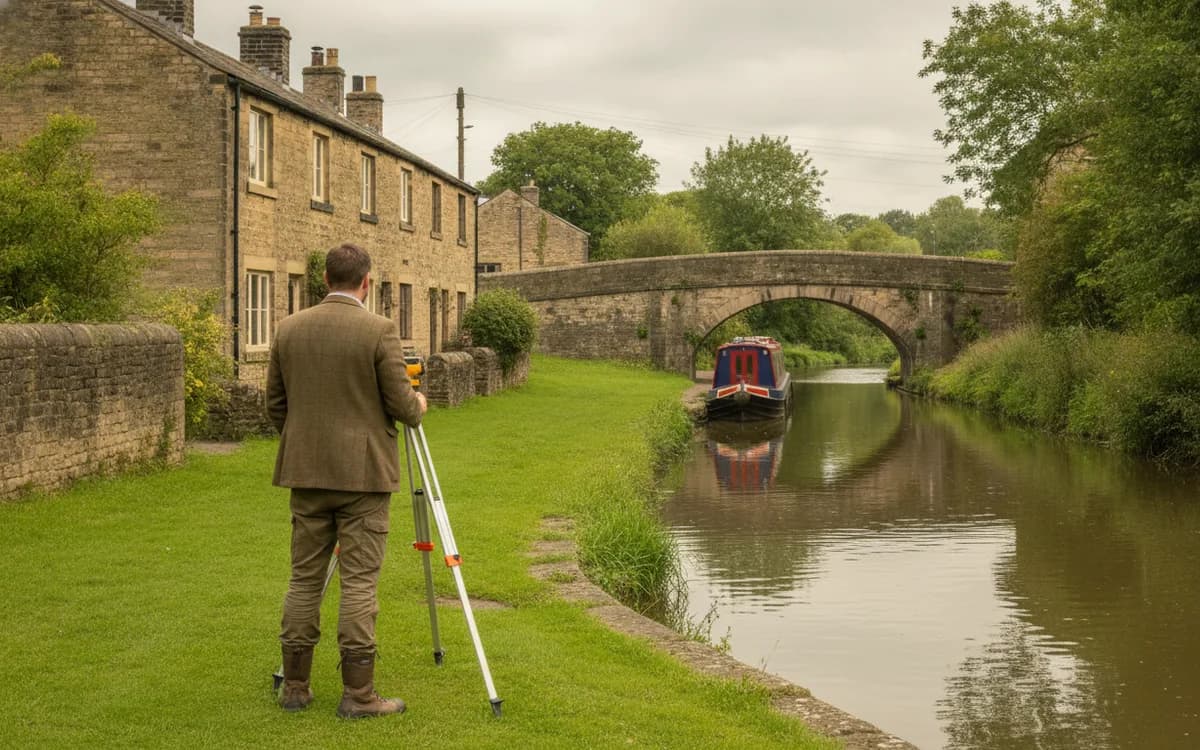
Surveying property in Mirfield
On paper most of that estate housing is textbook Level 2 Homebuyer Survey territory, and often it genuinely is. What makes Mirfield different from every other town on this site is that the survey level here is frequently decided by water rather than by age or construction. On Boxing Day 2015 the Calder came out across the low ground and put water through houses, ground floor flats and business premises along the valley, and the reinstatement that followed is now invisible. Fresh plaster, a new kitchen and a replacement floor look like an improved house. They can equally be the top layer over work that was rushed, done by whoever was available in a very busy few months, and never properly dried before it was covered up.
So the honest answer in this town is that a Level 2 is the right instruction on a great many properties and the wrong one on a house that has been under water. Tell us the address and what the seller has said about flooding when you call, and we will tell you which level the property needs before you commit to anything. The inspection is carried out by a qualified Chartered Surveyor, fully insured and VRS registered, and he is the person who writes the report and takes your call about it. Fees are fixed and confirmed in writing at the outset, attendance is normally within 3 to 5 working days of instruction, and the report reaches you within 3 to 5 working days of the visit.
The survey most often needed here
Level 2 Homebuyer Survey in Mirfield
A Level 2 Homebuyer Survey is the RICS mid-level inspection for conventional houses, flats and bungalows in reasonable condition. The surveyor inspects the visible and accessible parts of the property inside and out, tests for damp, checks the services on view, and reports each element with a simple traffic-light condition rating so you can see at a glance what needs attention before you exchange. It is written in plain English and includes advice on repairs and a reinstatement figure for insurance.
Suits Buyers of a conventional property built after around 1900 that has not been heavily altered and looks in reasonable condition.
River, navigation and the ground in between
The valley floor at Mirfield is soft. Beneath the houses on the level ground lies river alluvium, silts, sands and gravels laid down by the Calder, sitting over the Coal Measures sandstones and mudstones that form the rising land on either side. Alluvium is variable over short distances and it holds water, which is why a group of houses on the flat can behave quite differently from one another even though they were built in the same year by the same contractor. Shallow foundations on ground like that are sensitive to changes in groundwater, to leaking drains and to the drying effect of large trees, and settlement here is often about water rather than about load.
The navigation complicates the picture in a way that a buyer would not necessarily anticipate. Where a canal cut runs on or above the level of the land next to it, the water is retained by an embankment and by masonry washwalls, and the towpath, the bank and the wall itself may all belong to the navigation authority rather than to the house whose garden touches them. That affects who repairs a leaning washwall, who is liable if a bank slips, whether there is a right of way along the boundary and what you may build near it. It also means groundwater levels beside a cut do not fall the way they do elsewhere, so cellars and sunken rooms near the water are damp for structural reasons rather than for want of a chemical injection.
On the rising ground the problems reverse. The valley sides above Battyeford and towards Hopton shed water fast, and springs and land drains are common in gardens on the slope. Houses set into those slopes have retaining structures at the back and surface water arriving from above, so the report will look at where the water is being taken and whether the drive, the patio or a later extension has cut across the route it used to follow. Further east towards Ravensthorpe the Coal Measures were worked in places, and where cracking appears on a house in that direction we will say whether the pattern needs to be checked against a Coal Authority mining report or whether it has a more ordinary explanation.
Building materials sit somewhere between the Pennine stone towns and the brick of the lower valley. The older cottages and villas are local sandstone with stone slate or Welsh slate roofs, laid in lime and dependent on being able to dry out. The inter-war and post-war housing is brick, much of it rendered or dashed. The newest estates are cavity brick or block with concrete tiles. Each behaves differently when it gets wet, which becomes the central question on any property with a flood history, because a solid stone wall that has been soaked takes months to give up that water and a modern cavity wall with saturated insulation may never dry properly until the insulation is removed.
The 2015 floods, reinstatement and what we look for now
The Boxing Day flood is the single most important local fact for anybody buying in Mirfield, and eleven years on it is largely invisible from the pavement. Our job on an affected property is to read the building for evidence of what happened and, more importantly, for evidence of how well it was put back. The signs are consistent once you know them. Plasterwork renewed to a uniform height of about a metre and stopping in a straight horizontal line. A ground floor that is newer than the one above it. Skirtings, architraves and internal doors that are all the same age in an otherwise older house. Sockets moved up the wall, which is a sensible resilience measure and also a confession. Kitchen units with new carcasses on old wall lines. Fresh paint on masonry outside at low level and a tide line on a garden wall that nobody thought to repaint.
Then comes the harder question of whether the fabric was dry before it was covered. Property that was rushed back into use in 2016 was sometimes replastered while the walls still held a great deal of water, and the result is salting through the new plaster, blown patches at low level, persistently high moisture readings and a musty smell in a room that looks immaculate. We check the underfloor void where it can be reached, because suspended timber floors that were soaked and then boarded over without ventilation being restored are where rot takes hold quietly. We look at the condition of the wall plates and joist ends, at whether air bricks were reinstated and left clear, and at whether a solid floor has been laid over a void that should have stayed ventilated.
Insurance is the part buyers most often get wrong. A flood claim stays with the property in the underwriting sense, so the sensible sequence is to establish the position before you exchange, not after. Ask the seller directly whether the property has flooded, in what year, what was claimed, which insurer paid and whether the schedule of works survives. Ask whether any property flood resilience measures were installed, such as door barriers, non-return valves on the drainage, sump pumps or resilient plaster, because a house that has been sensibly adapted is a better risk than one that was simply put back as it was. Flood Re, the scheme that supports flood cover in household policies, is available on homes built before 1 January 2009, so a new house on the valley floor does not have that backstop behind it. Check that you can obtain buildings cover, on what excess, before you are contractually committed.
Not every flood in Mirfield comes from the river. Surface water running off the valley sides, overwhelmed highway drainage, blocked gullies and small culverted watercourses account for a fair share of the water that gets into buildings here, and those sources are not always reflected in the headline flood maps. The report records what we can see on the ground, the levels around the property, where its rainwater is discharged and whether a driveway or extension has blocked an old route, and it asks your solicitor to obtain a flood search so that you have the formal picture alongside the physical one.
Defects we see most in Mirfield homes
These are the faults our reports name most often in this town, and several of them are direct consequences of where the houses stand.
- Replastering carried out over walls that had not fully dried after flooding, showing as salt staining, blown patches at low level and moisture readings that do not fall with the seasons.
- Suspended timber ground floors boarded back over without ventilation being restored, with air bricks blocked, buried by a raised path or rendered across entirely.
- Leaning or bulging masonry washwalls and bank revetments where a garden meets the navigation, on which ownership and repairing liability are frequently unclear from the title plan.
- Riverbank erosion and undermined boundary structures on the gardens that run down to the Calder, along with self-seeded willow and alder that nobody has managed for twenty years.
- Localised settlement on the alluvial ground of the valley floor, usually traceable to a leaking drain run or a large tree rather than to inadequate foundations.
- Saturated cavity wall insulation in rendered post-war housing, where water is crossing the cavity at a failed detail and the wall cannot dry through a cement-rich external coating.
- Solid stone cottages at Hopton and Lower Hopton with raised external ground levels and cement pointing, damp at the base of the wall on the uphill side.
- Modern estate houses with shallow front gardens regraded by owners so that a path or a patio now sits within two courses of the damp-proof course.
Buying in Mirfield: level, access and the order of events
Mirfield sells on its position. It is a straightforward commute to Huddersfield, Leeds and Manchester, the schools draw people in and family houses on the better roads go under offer quickly, so buyers are usually working to somebody else's timetable. The way to keep control of that is to decide the survey level early. For a 1990s or 2000s house at Northorpe or Easthorpe with no flood history, a Level 2 Homebuyer Survey is proportionate and sufficient. For a stone cottage at Lower Hopton, a subdivided villa on Huddersfield Road, a barn conversion on the high ground or any property that has taken water, a Level 3 Building Survey earns its fee by explaining causes and consequences rather than simply listing what is visible.
Instruct once your offer is accepted and your solicitor has the file, and give us the address rather than just the postcode, because on this valley floor two houses a hundred metres apart can sit at quite different levels. We arrange access with the agent and we ask for the loft hatch clear, the meter cupboard open, any cellar or sunken utility room accessible, the underfloor access reachable if there is one, and the garden gate unlocked so that the surveyor can walk the whole boundary down to the water where a property backs onto the river or the cut.
Say what you noticed. A damp smell in a downstairs cupboard, a line on a garden wall, a floor that felt springy in one corner, a neighbour's remark about 2015. The surveyor will inspect with all of it in mind, and on a property with a flood history he will concentrate the inspection where the evidence actually sits rather than spreading it evenly across a house that is largely new inside. Where a property is in a conservation area or is listed, and Mirfield has designated buildings well beyond the obvious ones, the report records the designation, because it governs what you can alter and raises the question of consent for work already done.
When the inspection is finished you can ring the surveyor and go through it before anything is written down, which is often the most useful twenty minutes of the whole transaction. The written report follows within 3 to 5 working days. If it identifies something that needs a specialist, decay in floor timbers after flooding or movement that looks live, we can carry out the timber and damp report or instruct the structural engineer's report ourselves, so you can go back to the seller with evidence rather than an impression.
Other surveys and valuations we carry out in and around Mirfield
Besides Level 2 and Level 3 surveys, local clients come to us for timber and damp reports on flood-affected property, structural engineer's reports where settlement on the valley floor or a retaining structure on the slope needs a specialist view, drone roof surveys on tall villas and steeply pitched stone roofs, and valuations for probate, matrimonial settlements, Help to Buy redemptions and private sales within families. Buildings insurance reinstatement valuations are asked for more often here than in most towns, for the obvious reason that owners want cover set at a realistic figure before they need it. The practice was voted one of the best surveying companies in Leeds by its own customers in both 2024 and 2025.
We work across the surrounding villages on the same terms, so Ravensthorpe, Roberttown, Hopton and Lower Hopton are booked into the same diary with the same attendance targets and no change to the quoted fee. On the commercial side we survey shops, offices, workshops and canal-side industrial premises, prepare schedules of condition before a lease begins, advise on dilapidations at the end of a term, and carry out commercial valuations and rent reviews. Our Types of Survey page lists the full range, and if you cannot see what you need, telephone and tell us about the building.
Which level do I need
Level 2 or Level 3 for a Mirfield home?
The decision in four questions
Which survey level does a Mirfield property need?
Read down the left column. If most of your answers sit in the Level 2 column, a Level 2 Homebuyer Survey is usually enough. If two or more sit in the Level 3 column, instruct a Level 3 Building Survey. A valuation on its own only tells you what the property is worth, not what is wrong with it.
| Question | Points to Level 2 | Points to Level 3 |
|---|---|---|
| How old is the property? | Built after about 1900, conventional brick or block construction. | Victorian or older, timber-framed, thatched, listed or in a conservation area. |
| Has it been altered? | Original layout, or a straightforward extension with building control sign-off. | Extended, converted, loft conversion, removed walls, or unknown history of works. |
| What condition does it look in? | Well kept, no obvious cracking, damp or roof problems. | Visible cracking, damp patches, sagging roof, or it has been empty for a while. |
| What do you want from the report? | A clear condition rating on each element and a list of what to check before exchange. | The cause of each defect, repair options, priorities and a discussion with the surveyor. |
Still on the fence? Call 07970 562 963 and describe the property. It takes two minutes and the surveyor will tell you straight which level fits and what it will cost.
Common questions in Mirfield
Survey questions from Mirfield buyers
Does a flood history stop me getting a mortgage on a Mirfield house?
Usually not by itself. Lenders are concerned with whether the property can be insured and whether it has been properly repaired, so the practical obstacle is buildings cover rather than the lending decision. Get an insurance quotation in your own name before you exchange, and make sure the survey addresses the quality of the reinstatement, because a lender's valuer who sees damp readings in a recently replastered room is likely to retain part of the advance.
How can I tell whether flood reinstatement work was done properly?
You look for evidence of drying rather than evidence of decoration. Well managed reinstatement leaves a paper trail of drying records, a dated schedule of works and, very often, resilience measures such as raised sockets and non-return valves. Poor reinstatement shows as salting or blown plaster at low level, high moisture readings that do not vary with the weather, a musty smell and covered underfloor voids with no reinstated ventilation.
Is Flood Re available on property in Mirfield?
It depends on the house rather than the street. Flood Re backs the flood element of household insurance for homes built before 1 January 2009, so an older cottage or an established estate house on the valley floor can benefit from it while a recently built house on the same ground cannot. Leasehold flats and some commercial and mixed use property are treated differently again. Confirm the position with an insurer before you are committed to the purchase.
Is a Level 2 enough for a modern house on a Mirfield estate?
On a house of that kind with no history of water entry, yes, and we will not try to talk you into more. The construction is conventional, the materials are familiar and the defects tend to be workmanship issues, drainage falls and missing cavity trays rather than anything structural. Where a newer house sits on low ground near the river the calculation changes, because a modern cavity wall with wet insulation is a slow and disruptive thing to put right.
What extra checks does a canal-side property in Mirfield need?
Three in particular. Who owns the towpath and the bank, since the navigation authority commonly does and that affects access and liability. What condition the masonry washwall or revetment is in, because they lean and bulge as they age and repairing one is expensive. And how the retained water level affects the building, since groundwater beside a cut does not drop away, so basements and sunken rooms nearby stay damp regardless of any treatment applied inside.
The garden runs down to the River Calder. What does that mean for the survey?
The surveyor walks the whole length of it. We look at whether the bank is being cut back by the current, whether boundary walls or outbuildings near the water are being undermined, whether large self-seeded trees are destabilising the bank or blocking the channel, and how far the building stands above normal river level. Riparian owners carry real maintenance duties for the bank, so the report asks your solicitor to establish exactly where your responsibility ends.
Should I order a flood search as well as the survey?
Yes, they answer different questions. The search gives you the recorded and modelled risk from rivers, surface water and groundwater at that address, drawn from data we cannot see on site. The survey tells you what the building itself shows: the levels around it, where its rainwater goes, whether a path or extension has blocked an old drainage route and whether there is physical evidence of past water entry inside.
Does the report include an insurance reinstatement figure?
It does. That figure is the cost of rebuilding the property, including demolition, site clearance and professional fees, and it is not the same as the market value or the price you are paying. In this valley it is worth attending to, because underinsurance only reveals itself at the point of a claim, which in Mirfield is precisely the moment when a shortfall causes the most damage.
Can you fit a Mirfield survey in before a tight exchange date?
Often, yes. The standard target is attendance within 3 to 5 working days of instruction and the written report within 3 to 5 working days of the visit. Where a chain is about to collapse or an exchange date has been forced on you, attendance within 24 hours can be arranged on request, and the surveyor will talk you through the findings by telephone straight after the inspection rather than leaving you to wait for the document.
Do you survey the stone cottages at Hopton and Lower Hopton?
Regularly. Those are solid walled sandstone buildings with no cavity, frequently with a stone slate roof and an external ground level that has crept up over the years, and they need to be read as breathing structures rather than as sealed ones. They generally justify a Level 3 Building Survey, which explains why a wall is wet and what a breathable repair involves, instead of a report that records the dampness and refers you elsewhere.
Is damp near the canal always rising damp?
Almost never as simply as that. In this part of the valley the usual causes are a high and stable water table beside retained water, external ground raised above the damp-proof course, a failed or bridged cavity, rainwater goods discharging against a wall and condensation in rooms that were sealed up with new glazing and no replacement ventilation. Diagnosing which one is at work decides the repair, and injecting a chemical course into the wrong one wastes money.
Who will actually carry out my Mirfield survey?
A qualified Chartered Surveyor who is fully insured and VRS registered, working within a practice with over 50 years of combined experience. The same person inspects the property, writes the report and answers your questions about it, and no part of the work is passed to a third party or a panel. That continuity matters most on a property with a flood history, where what the surveyor saw on the day is the thing you will want to discuss.
Also covered from Mirfield
We survey Ravensthorpe, Roberttown, Hopton and Lower Hopton from our Mirfield work, at the same fixed fee. Travel is included, so the figure does not change because the property sits on the edge of the patch.
Book your survey
Book a survey in Mirfield
Postcode, survey type and a phone number. The surveyor will come back with a fixed fee for the Mirfield property and the earliest date.
Prefer to talk it through first?
Call 07970 562 963