West Yorkshire surveyors
RICS Chartered Surveyors in Leeds
Leeds has a housing stock unlike anywhere else in the country, and the reason is the back-to-back. The city built them later and kept more of them than any other place in Britain, and thousands are still lived in across Harehills, Beeston, Holbeck, Armley, Burley and Hyde Park. Around them sit red-brick through terraces in Meanwood, Kirkstall and Chapel Allerton, Victorian and Edwardian villas in Headingley and Roundhay, vast inter-war semi-detached suburbs at Moortown, Alwoodley, Crossgates and Halton, post-war estates at Seacroft, Middleton and Halton Moor, and a city centre where old mills and warehouses have become flats alongside apartment blocks from the 2000s.
A Level 2 Homebuyer Survey in Leeds covers the condition of the property's structure, services and grounds, flagging urgent repairs with a traffic-light rating. It suits conventional through terraces, inter-war semis and modern homes across the city in reasonable condition, with the surveyor attending within 3 to 5 working days of instruction.
Surveying property in Leeds
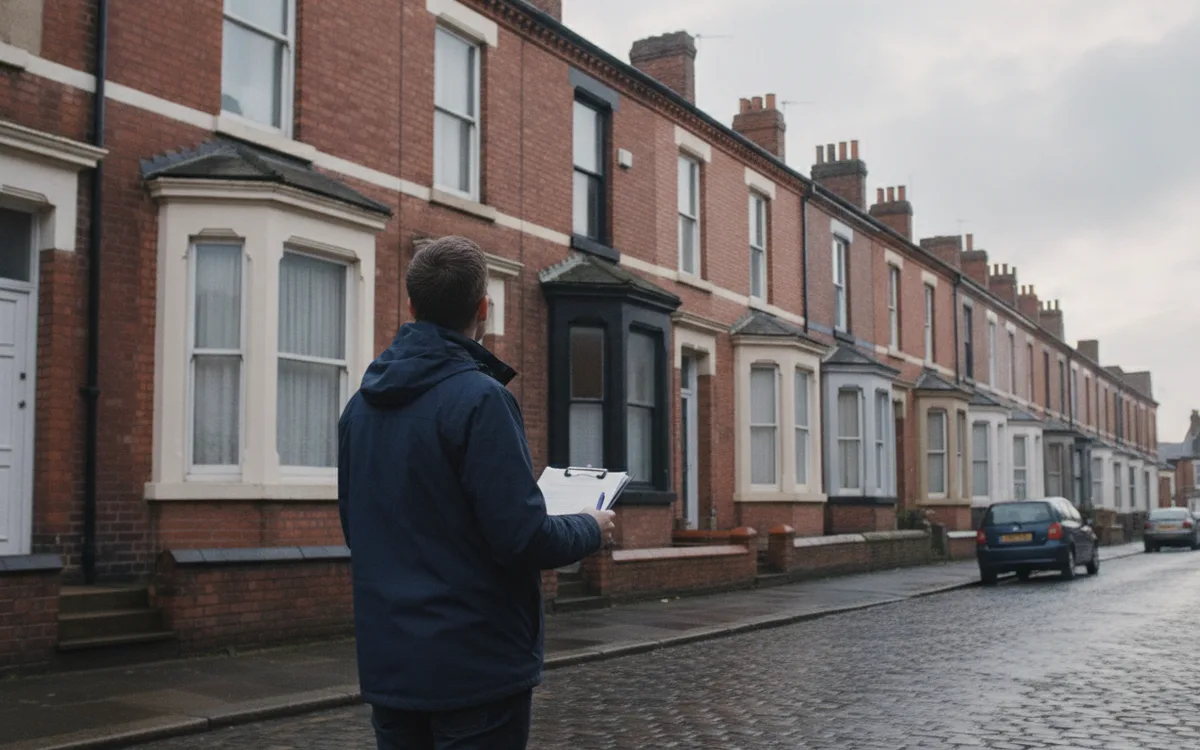
That range is why the survey level matters so much here. A 1930s semi in Moortown with its original layout and a sound roof is a textbook Level 2 Homebuyer Survey. A three-storey back-to-back in Harehills with a cellar, a shared party wall on three sides and a century of patch repairs is a different proposition, and a Level 2 report on it would mostly tell you to take further advice. We carry out both, and we will tell you honestly which one the property in front of you needs before you instruct us.
The surveyor who inspects your Leeds property is the one who writes the report and the one you speak to before and after. Fees are fixed and quoted in full, we aim to attend within 3 to 5 working days of instruction, and the report follows within 3 to 5 working days of the visit. If your exchange date is tighter than that, say so when you enquire, because 24-hour attendance is available on request.
The survey most often needed here
Level 2 Homebuyer Survey in Leeds
A Level 2 Homebuyer Survey is the RICS mid-level inspection for conventional houses, flats and bungalows in reasonable condition. The surveyor inspects the visible and accessible parts of the property inside and out, tests for damp, checks the services on view, and reports each element with a simple traffic-light condition rating so you can see at a glance what needs attention before you exchange. It is written in plain English and includes advice on repairs and a reinstatement figure for insurance.
Suits Buyers of a conventional property built after around 1900 that has not been heavily altered and looks in reasonable condition.
What Leeds ground and buildings tell a surveyor
Leeds sits on the Coal Measures, a layered sequence of sandstone, mudstone and coal seams that runs under most of the city. For a surveyor that has two practical consequences. The first is that a great deal of south and west Leeds, taking in Middleton, Beeston, Rothwell, Armley and Wortley, sits above ground that was worked for coal, often at shallow depth and often long before anyone recorded it properly. Where the survey or the ground conditions suggest it, the report will tell your solicitor to obtain a Coal Authority mining report, and we will say plainly whether the cracking we can see is consistent with mining movement or with something far more ordinary.
The second is stone. The older buildings in the city and almost everything in the outer townships were built from local sandstone, and sandstone is porous. It was laid in lime mortar so that the wall could take up moisture and give it back. Repointing that same wall in hard cement traps the water inside the stone, and the face of the stone then blows off in frosts. Sandblasting does the same damage faster by stripping the weathered skin. Both are common in Leeds and both are recorded in detail in our reports, because the repair is expensive and the damage is cumulative.
Water is the third consideration. The Aire runs through the city and the Boxing Day floods of 2015 reached property along Kirkstall Road, in Woodlesford and through the lower Aire valley. The Leeds Flood Alleviation Scheme has changed the picture since, but a surveyor still looks for tide marks in cellars, perished plaster at low level, replaced floors and inadequate underfloor ventilation, and the report will point your solicitor at a flood search where the setting calls for one.
Back-to-back houses, and why they need a surveyor who knows them
A Leeds back-to-back is joined to its neighbours on three sides. Only one elevation is external, which means there is no through ventilation, no rear access and no second aspect to dry the building out. Most were built between the 1880s and the 1930s, most have a cellar, many are three storeys, and a great many have been altered without paperwork.
The defects follow from the form. Damp is the big one, because a single external wall carries all the weathering and the cellar sits below the ground outside it. Original ventilation to the cellar head has often been blocked up. Rear bedrooms in three-storey examples can be poorly lit and badly ventilated, and condensation mould in them is routine rather than exceptional. Chimney stacks are shared and are frequently in poor order above roof level, where nobody looks. Roof coverings are often original stone slate or Welsh slate nailed with corroded fixings.
None of this makes a back-to-back a bad buy. They are among the most affordable houses in the city and many are structurally sound and perfectly comfortable. What it does mean is that the inspection has to be done by somebody who has been in a hundred of them and knows where to look, and that a Level 3 Building Survey is usually the right instruction rather than a Level 2, particularly where the house has been converted, extended into the cellar, or let out for a long period.
Defects we see most in Leeds homes
Every city has its patterns. In Leeds the ones that come up again and again are these.
- Cement repointing and sandblasting on local sandstone, trapping moisture and spalling the face of the stone, especially on exposed elevations in the outer townships.
- Spray foam insulation applied to the underside of roof coverings in loft conversions and retrofits, which several lenders will not accept and which hides the condition of the timbers underneath.
- Damp at low level in back-to-backs and cellared terraces across Harehills, Beeston, Holbeck and Armley, where external ground levels have risen above the original damp-proof course.
- Non-standard construction on post-war estates at Seacroft, Middleton and Halton Moor, including Airey, Wimpey No-Fines and BISF steel-framed houses, which affect both mortgageability and the repair strategy.
- Cavity wall tie corrosion in inter-war semis at Moortown, Crossgates and Halton, showing as horizontal cracking at regular courses on the weather elevation.
- Roof spread and nail sickness on original stone slate roofs, where the covering is very heavy and the original timbers were sized for it but the fixings have long since gone.
- Loft conversions and through-lounge alterations in terraced housing with no building regulation completion certificate, common in Headingley, Hyde Park and Burley where houses have been in student letting for years.
- Cladding, balcony and fire safety questions on city-centre apartment blocks built in the 2000s, which affect saleability as much as condition and which your solicitor needs to pursue with the management company.
Buying in Leeds: how the survey fits the timetable
Leeds moves quickly in the areas people want. Family houses in Moortown, Chapel Allerton, Meanwood and Horsforth go under offer in days, and agents expect buyers to be organised. The right moment to instruct the survey is as soon as your offer is accepted and your solicitor is instructed, so the findings reach you before searches come back and before you commit to a mortgage product.
We arrange access with the agent directly. Most of the city's agents know our surveyors and know we need the loft hatch unlocked, the cellar accessible, the meter cupboards open and the yard gates unbolted. If something worried you at the viewing, a crack over a bay, a smell in a cellar, a roof that looked tired from the pavement, tell us beforehand and the surveyor will inspect with that in mind.
After the inspection you can ring the surveyor and talk the findings through while they are fresh. The written report follows within 3 to 5 working days. Where it flags something significant, movement on a terrace in south Leeds for instance, we can follow up with a structural engineer's report or a timber and damp investigation, so you go into a renegotiation with figures rather than worries.
Leeds has a large number of conservation areas, from Headingley Hill and Chapel Allerton to the city-centre warehouse quarters, and an Article 4 direction covering much of the student belt that restricts conversion to shared housing. Where a property sits inside one, the report says so, because it changes what you can do to the building and what consents a previous owner should have obtained.
Other surveys and valuations we carry out in Leeds
Alongside Level 2 and Level 3 surveys, Leeds buyers and owners instruct us for structural engineer's reports where movement or mining is suspected, timber and damp reports on cellared terraces, drone roof surveys where a tall Victorian roof or a mill conversion cannot be seen from the ground, and valuations for probate, matrimonial settlements, Help to Buy redemptions and private sales between family members. For landlords and freeholders across the city's many converted houses and blocks we provide building insurance valuations and fire risk assessments for the common parts.
Commercial clients in Leeds instruct us for building surveys on shops, offices and industrial units, schedules of condition before a lease begins, dilapidation advice at the end of one, and commercial valuations and rent reviews. The full list is on our Types of Survey page, and if what you need is not obviously there, call and ask.
Which level do I need
Level 2 or Level 3 for a Leeds home?
The decision in four questions
Which survey level does a Leeds property need?
Read down the left column. If most of your answers sit in the Level 2 column, a Level 2 Homebuyer Survey is usually enough. If two or more sit in the Level 3 column, instruct a Level 3 Building Survey. A valuation on its own only tells you what the property is worth, not what is wrong with it.
| Question | Points to Level 2 | Points to Level 3 |
|---|---|---|
| How old is the property? | Built after about 1900, conventional brick or block construction. | Victorian or older, timber-framed, thatched, listed or in a conservation area. |
| Has it been altered? | Original layout, or a straightforward extension with building control sign-off. | Extended, converted, loft conversion, removed walls, or unknown history of works. |
| What condition does it look in? | Well kept, no obvious cracking, damp or roof problems. | Visible cracking, damp patches, sagging roof, or it has been empty for a while. |
| What do you want from the report? | A clear condition rating on each element and a list of what to check before exchange. | The cause of each defect, repair options, priorities and a discussion with the surveyor. |
Still on the fence? Call 07970 562 963 and describe the property. It takes two minutes and the surveyor will tell you straight which level fits and what it will cost.
Common questions in Leeds
Survey questions from Leeds buyers
How much does a Level 2 Homebuyer Survey cost in Leeds?
The fee depends on the property's size, age, type and value, and it is fixed and confirmed in writing before you instruct us, so you know the full cost up front with no hidden charges. Tell us the Leeds postcode and the asking price and we will confirm a fixed fee.
Do I need a Level 2 or a Level 3 survey on a Leeds back-to-back?
Usually a Level 3 Building Survey. A back-to-back is attached on three sides with one external elevation, no through ventilation and very often a cellar, and most have been altered over the years without paperwork. A Level 3 explains the cause of each defect and sets out repair options and priorities, which is what you need on a house of that form. A Level 2 would frequently do no more than tell you to take further advice.
Should I worry about old coal mining under a Leeds property?
It is worth checking rather than worrying. Much of south and west Leeds, including Middleton, Beeston, Rothwell, Armley and Wortley, sits above ground worked for coal, sometimes at shallow depth. The survey records any cracking and assesses whether the pattern is consistent with mining movement, historic settlement or something ordinary, and where it is relevant the report tells your solicitor to obtain a Coal Authority mining report.
Will the survey pick up spray foam insulation in the loft?
Yes, and it matters. Spray foam applied to the underside of the roof covering hides the condition of the timbers and the fixings beneath it, and a number of lenders will not lend on a property that has it. Where we find it the report explains what it prevents us from inspecting, what the likely lender position is, and what removal usually involves.
How quickly can you survey a property in Leeds?
We aim to attend within 3 to 5 working days of instruction, subject to access, and to send the report within 3 to 5 working days of the visit. If you have a tight exchange date, tell us when you enquire, because 24-hour attendance is available on request.
Can you survey a flat in a Leeds mill or warehouse conversion?
Yes. For a converted mill or warehouse the surveyor inspects the flat itself and the accessible common parts, and comments on the condition of the building as a whole, the roof, the external walls and the communal areas, because you will pay towards repairing them through the service charge. Conversions of this kind often have large single-ply or felt roof areas, exposed structural frames and shared services, and the report says what to ask the management company for.
What does flooding along the River Aire mean for a survey?
The surveyor looks for evidence of past water entry in low-lying property near the Aire, including tide marks in cellars, perished plaster at low level, replaced floors and blocked underfloor ventilation, and will draw your solicitor's attention to the need for a flood search where the location suggests it. The insurance reinstatement figure in the report also reflects the setting.
Does the survey cover the electrics and boiler in a Leeds house?
The surveyor makes a visual inspection of the services on view, the consumer unit, visible wiring, the boiler, radiators and pipework, and reports on their apparent age and condition. Surveyors do not test the systems. Where an installation looks dated or there is no service history, the report recommends an electrician's or gas engineer's test before exchange.
Do you survey ex-council and non-standard houses in Leeds?
We do, and they need identifying correctly. Estates at Seacroft, Middleton and Halton Moor include Airey and Wimpey No-Fines concrete houses and BISF steel-framed houses. Some types are designated defective, some have been repaired under approved schemes and some are straightforward, and the difference decides both what a lender will do and what the property is worth. The report names the construction type and explains the consequences.
Can I speak to the surveyor before they visit my Leeds property?
Yes, and we encourage it. If you noticed a crack over a bay window, a damp smell in a cellar or a tired-looking roof at the viewing, tell the surveyor beforehand and they will inspect with that in mind. You can also call after the visit to talk the findings through before the written report arrives.
What happens if the Leeds survey finds serious problems?
The report tells you what the defect is, how urgent it is and what to do next, whether that is obtaining quotes, asking the seller to put it right, renegotiating the price or occasionally walking away. Where something needs specialist investigation, suspected structural movement or timber decay for example, we can carry out that follow-up report for you.
Do you carry out valuations in Leeds as well as surveys?
Yes. We provide private valuations, probate valuations, matrimonial valuations, Help to Buy valuations and building insurance valuations across the city. A valuation gives you a figure and does not report on condition, so if you need both, a Level 2 Homebuyer Survey includes a valuation as part of the report.
Also covered from Leeds
We survey Morley, Pudsey, Horsforth, Garforth, Rothwell, Otley, Guiseley and Yeadon from our Leeds work, at the same fixed fee. Travel is included, so the figure does not change because the property sits on the edge of the patch.
Book your survey
Book a survey in Leeds
Postcode, survey type and a phone number. The surveyor will come back with a fixed fee for the Leeds property and the earliest date.
Prefer to talk it through first?
Call 07970 562 963