
West Yorkshire surveyors
RICS Chartered Surveyors in Bradford
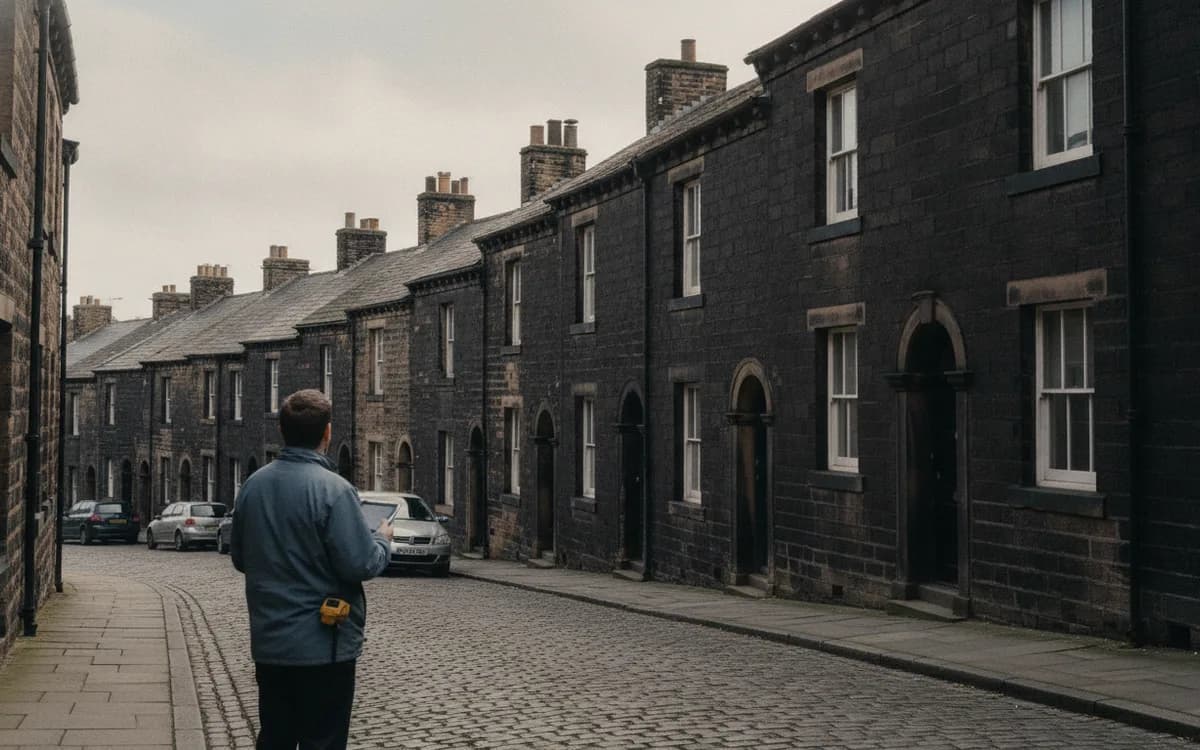
Bradford is a stone city built in a bowl. The ground falls away from the moors on almost every side towards the centre, and the streets were laid out across those slopes rather than around them, which is why so much of the district is built on ground that steps. Whole terraces in Great Horton, Girlington, Manningham and Wibsey sit with a cellar exposed at the front and buried at the back, or the other way about. Above them stand the merchant villas of Manningham and Heaton, built when the worsted trade was at its height, and below them the warehouses of Little Germany, now largely flats.
A Level 3 Building Survey in Bradford examines the structure and fabric in detail, explains the cause of each defect and sets out repair options and priorities. It suits the district's solid gritstone terraces, back-to-backs and Victorian villas, with the surveyor attending within 3 to 5 working days of instruction.
Surveying property in Bradford
What unites nearly all of it is millstone grit. Bradford built in local sandstone because the quarries were on the doorstep, and sandstone behaves differently from the brick most surveyors elsewhere spend their days looking at. It is porous, it was bedded in lime, and it needs to breathe. A great deal of what we record in this district traces back to somebody treating a stone wall as if it were a brick one.
Because of that, Bradford sees a higher proportion of Level 3 Building Surveys than most places. A solid-walled stone terrace with a cellar, a stone slate roof and a hundred and thirty years of alterations is not a Level 2 property, and a Level 2 report on it tends to say very little beyond take further advice. We carry out both levels and we will tell you plainly which one the house needs before you instruct us. The surveyor who inspects it writes the report and takes your call afterwards. Fees are fixed, attendance is within 3 to 5 working days, and the report follows 3 to 5 working days after the visit.
The survey most often needed here
Level 3 Building Survey in Bradford
A Level 3 Building Survey (formerly the full structural survey) is the most thorough RICS inspection. It suits period homes, listed buildings, timber-framed and non-standard construction, properties that have been extended or altered, and anything in poor condition. The surveyor examines the structure and fabric in detail, explains the likely cause of any defect, sets out repair options and priorities, and discusses the findings with you before and after the inspection.
Suits Buyers of pre-1900 or period property, listed and conservation-area homes, extended or converted houses, non-standard construction, or any property showing signs of movement, damp or neglect.
Millstone grit, and what it does when it is treated wrongly
Local sandstone is an excellent building material and there are walls in this district standing sound after a hundred and fifty years. It works because the stone is laid in a soft lime mortar that takes up moisture and releases it, and because the outer face of the stone develops a weathered skin that protects what is behind it. Two common interventions destroy both of those things.
The first is hard cement pointing. Cement is stronger and far less permeable than the stone around it, so water that gets into the wall cannot leave through the joint and leaves through the face of the stone instead. In a hard frost the wet face lifts off. You can read the history of a street's repointing from the pavement, because the cement-pointed houses are the ones with crumbling, sanded-back stonework and the lime-pointed ones are not.
The second is grit blasting. Cleaning soot off a Victorian frontage is understandable, and a great many Bradford houses were blasted in the decades after the Clean Air Acts. Blasting strips the weathered skin and opens the pores, and a blasted elevation absorbs water for the rest of its life. Where we find one the report says so, explains that the damp readings inside are a consequence rather than a coincidence, and sets out what a breathable repair looks like.
Rubble-built walls add a third consideration. Many Bradford walls are two skins of stone with a rubble core, tied at intervals by long through-stones. Where through-stones are missing, corroded or were never adequate, the outer skin can start to separate, which shows as bulging rather than cracking. It is not a subtle defect once you know to look for it, and it is not something a valuation inspection would catch.
Stone slate roofs and the loads nobody plans for
The traditional roof covering here is stone slate, thick sandstone flags laid in diminishing courses with the largest at the eaves. It is a superb covering and it is extraordinarily heavy, several times the weight of a modern concrete tile. The roof structures beneath were sized for that weight, using large section timbers at close centres.
Two problems follow. The first is nail sickness. The flags were hung on oak pegs or iron nails, and after a century the fixings fail even though the stone is perfectly sound. Slipped flags, a patchwork of replacements and a roof that has been repeatedly repaired from the outside are the signs. Stripping and relaying a stone slate roof is a substantial cost and the report gives you a realistic view of where the covering sits in its life.
The second is what happens when somebody replaces the stone with something lighter. That sounds sensible and often is, but a roof structure designed for a heavy covering that is then loaded with a light one can behave in unexpected ways, and a roof that was spreading under stone will not necessarily stop. More often we find the opposite: a light covering replaced later with reclaimed stone by an owner who wanted the original look, on a structure that was reduced when the first change was made. Either way the survey looks at the covering, the structure and the relationship between them rather than just noting the material.
Defects we see most in Bradford homes
The district has its own pattern of recurring faults, and these are the ones our reports name most often.
- Cement pointing and grit-blasted elevations on sandstone terraces, driving persistent penetrating damp on the weather side and spalling the face of the stone.
- Bulging outer skins on rubble-cored walls where the through-stones have failed, most visible on long unbroken terrace frontages.
- Nail sickness and slipped flags on original stone slate roofs, and roof structures altered when a covering was changed.
- Retaining walls and stepped foundations on the district's steep streets, where garden and boundary walls hold back significant ground and have often never been maintained.
- Cellars driven into the hillside that are dry at one end and saturated at the other, with blocked or built-over original ventilation.
- Back-to-backs and through terraces converted into flats without building regulation approval, particularly in Manningham, Girlington and Great Horton, where fire separation and sound insulation are frequently absent.
- Shallow historic coal workings on the Coal Measures beneath parts of the district, where cracking needs assessing against a Coal Authority mining report rather than guessed at.
- Culverted watercourses, including Bradford Beck and its tributaries, running beneath property in and around the city centre, where responsibility for the culvert can pass with the title.
Buying in Bradford: values, repair costs and getting the order right
Bradford has some of the most affordable housing anywhere in the north, and that creates a specific risk that we are blunt about in our reports. When a house costs relatively little, the cost of a full repair schedule can represent a large share of the purchase price, and occasionally more than it. A stone terrace needing a roof, repointing and a damp strategy can absorb a sum that would be a rounding error on a southern property and is a serious proportion of the value here.
That is not an argument against buying. It is an argument for knowing the number before you exchange rather than after, and for sequencing the work correctly. Our reports set repairs out in order of urgency and explain which ones unlock the others, because doing them in the wrong order wastes money. There is no sense replastering a wall before the pointing outside it has been put right.
Instruct the survey as soon as your offer is accepted and your solicitor is instructed. We arrange access through the agent and we need the cellar open, the loft hatch unlocked and the yard gate unbolted, because on a stepped site the back of the house often tells a different story from the front. If something concerned you at the viewing, say so beforehand and the surveyor will go looking.
The district has a large number of listed buildings and conservation areas, from the Little Germany warehouse quarter and the Manningham villas to Saltaire on the Shipley side. Where a property sits inside one, the report says so, and where alterations look as though they should have had listed building consent it flags the question for your solicitor, because unauthorised work on a listed building becomes the next owner's problem.
Other surveys and valuations we carry out in Bradford
Besides Level 2 and Level 3 surveys, Bradford clients instruct us for structural engineer's reports where a wall is bulging or a retaining structure is moving, timber and damp reports on cellared stone property, drone roof surveys where a tall stone slate roof or a mill conversion cannot be seen safely from the ground, and valuations for probate, matrimonial settlements and private sales. Landlords and freeholders across the district's many converted villas instruct us for building insurance valuations and fire risk assessments of the common parts.
On the commercial side we survey shops, offices, mills and industrial units across the district, prepare schedules of condition before a lease starts, advise on dilapidations at the end of one, and carry out commercial valuations and rent reviews. We also cover Shipley, Saltaire, Bingley, Baildon, Ilkley, Queensbury and Thornton from the same base. The full service list is on our Types of Survey page.
Which level do I need
Level 2 or Level 3 for a Bradford home?
The decision in four questions
Which survey level does a Bradford property need?
Read down the left column. If most of your answers sit in the Level 2 column, a Level 2 Homebuyer Survey is usually enough. If two or more sit in the Level 3 column, instruct a Level 3 Building Survey. A valuation on its own only tells you what the property is worth, not what is wrong with it.
| Question | Points to Level 2 | Points to Level 3 |
|---|---|---|
| How old is the property? | Built after about 1900, conventional brick or block construction. | Victorian or older, timber-framed, thatched, listed or in a conservation area. |
| Has it been altered? | Original layout, or a straightforward extension with building control sign-off. | Extended, converted, loft conversion, removed walls, or unknown history of works. |
| What condition does it look in? | Well kept, no obvious cracking, damp or roof problems. | Visible cracking, damp patches, sagging roof, or it has been empty for a while. |
| What do you want from the report? | A clear condition rating on each element and a list of what to check before exchange. | The cause of each defect, repair options, priorities and a discussion with the surveyor. |
Still on the fence? Call 07970 562 963 and describe the property. It takes two minutes and the surveyor will tell you straight which level fits and what it will cost.
Common questions in Bradford
Survey questions from Bradford buyers
How much does a Level 3 Building Survey cost in Bradford?
The fee is set by the property's size, age, type and value, and it is fixed and confirmed in writing before you instruct us, with no hidden charges. Give us the Bradford postcode and the asking price and we will confirm a figure.
Why do so many Bradford houses need a Level 3 rather than a Level 2?
Because of how they are built. A solid gritstone wall with no cavity, a cellar cut into a slope, a stone slate roof and a long history of alteration sits outside what a Level 2 Homebuyer Survey is designed for. A Level 3 Building Survey explains the cause of each defect, sets out repair options and priorities and discusses them with you. On a conventional post-1930 semi in the outer suburbs a Level 2 is often perfectly adequate, and we will say so.
My survey mentions grit blasting. Why does that matter?
Blasting removes the weathered outer skin of the sandstone and opens up the pores beneath it, so the elevation absorbs and holds far more water than it was built to. That usually shows inside as persistent damp on the weather-facing wall. It cannot be undone, but it can be managed with breathable pointing, sensible rainwater goods and the right internal finishes, and the report explains the approach.
What is a through-stone and why would the report mention one?
Many Bradford walls are built as two leaves of stone with a rubble fill between them, bonded together by long stones that run right through the thickness of the wall. When those through-stones are too few, badly placed or have corroded fixings nearby, the outer leaf can begin to separate and the wall bulges outward rather than cracking. It is a structural matter and the report will recommend a structural engineer's report where the movement looks active.
How quickly can you survey a property in Bradford?
We aim to attend within 3 to 5 working days of instruction, subject to access, and to issue the report within 3 to 5 working days of the visit. Tell us if your exchange date is tight, because attendance within 24 hours can be arranged on request.
Is coal mining a concern for property in the Bradford district?
In parts of it, yes. The district sits on the Coal Measures and there were shallow workings in several areas, often unrecorded. The survey assesses whether any cracking present is consistent with mining movement or with something more ordinary such as thermal movement or a failed lintel, and where it is relevant the report tells your solicitor to obtain a Coal Authority mining report before exchange.
Can you survey a flat in a Little Germany or mill conversion?
Yes. The surveyor inspects the flat and the accessible common parts and comments on the building as a whole, because you contribute to repairing it through the service charge. Warehouse and mill conversions typically have very large roof areas, exposed structural frames, single-glazed or secondary-glazed historic windows and shared services, and the report sets out what to ask the management company to produce.
The house is cheap. Is a survey still worth the fee?
More so, not less. Where values are modest, a roof, a repointing job and a damp strategy can account for a large share of what you are paying for the house, so the gap between an informed offer and a hopeful one is proportionally much wider. The report prices the risk and puts the repairs in the order that makes financial sense.
Does the survey look at boundary and retaining walls?
It does, and on Bradford's stepped sites they matter more than people expect. Garden and boundary walls here often retain a real depth of ground, and a leaning or bulging retaining wall is a liability rather than a cosmetic issue. The report comments on their condition and, where ownership looks unclear, asks your solicitor to establish who is responsible.
Can I speak to the surveyor before the inspection?
Yes, and it makes the survey better. If you noticed a bulge in a frontage, a damp smell in a cellar or a patched roof at the viewing, tell the surveyor and they will inspect with that in mind. You can also ring after the visit to talk through the findings before the written report reaches you.
Do you cover Shipley, Saltaire, Bingley and Ilkley as well?
Yes. Those towns are all within the Bradford district and we survey across the whole of it, including Baildon, Queensbury, Thornton and the villages on the moor edge. Travel is included in the fixed fee we quote, so the figure does not change because the property sits at the far side of the district.
Do you carry out valuations in Bradford as well as surveys?
Yes. We provide private valuations, probate valuations, matrimonial valuations, Help to Buy valuations and building insurance valuations throughout the district. A valuation produces a figure and does not report on condition, so where you need both, a Level 2 Homebuyer Survey includes a valuation within the report.
Also covered from Bradford
We survey Shipley, Saltaire, Bingley, Baildon, Ilkley, Queensbury and Thornton from our Bradford work, at the same fixed fee. Travel is included, so the figure does not change because the property sits on the edge of the patch.
Book your survey
Book a survey in Bradford
Postcode, survey type and a phone number. The surveyor will come back with a fixed fee for the Bradford property and the earliest date.
Prefer to talk it through first?
Call 07970 562 963