West Yorkshire surveyors
RICS Chartered Surveyors in Dewsbury
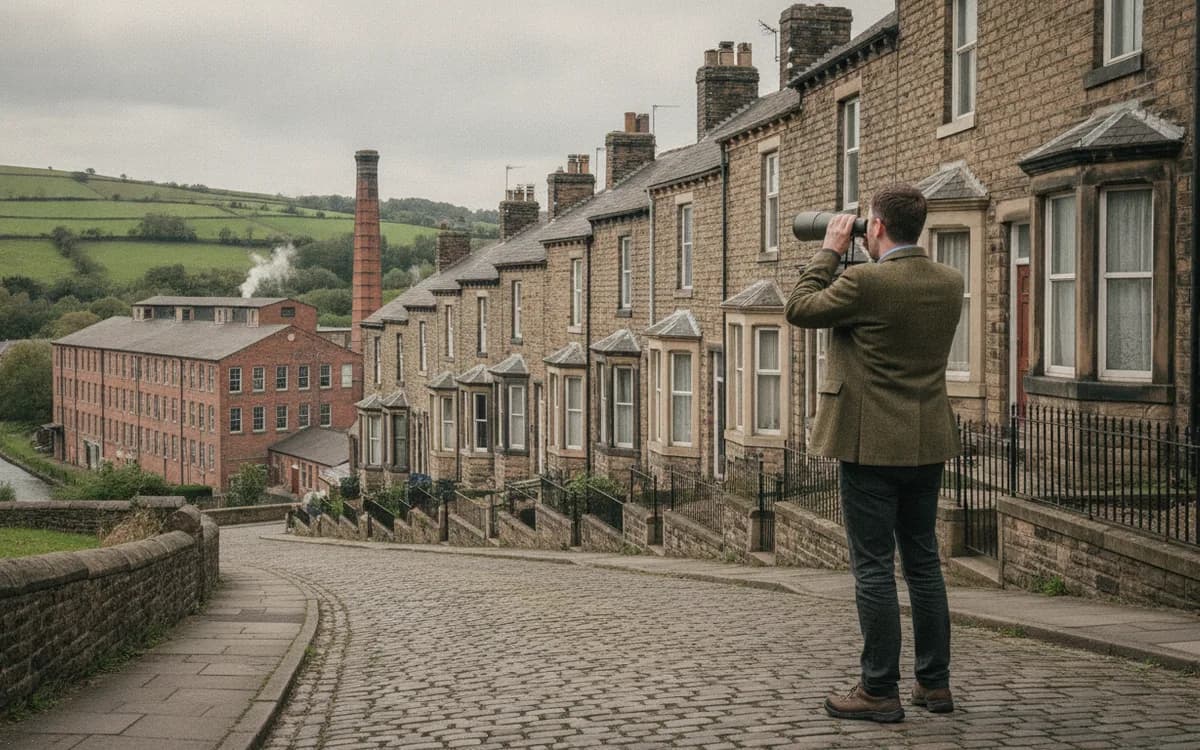
Dewsbury made its money out of other people's cast-offs. The mills of the Heavy Woollen district ground worn cloth back into fibre, shoddy from soft woollens and mungo from harder felted stuff, and the trade that paid for the town is still written into its housing. Long rows of terraces, some stone, some brick and a good many both, run through Westtown, Savile Town, Thornhill Lees and Ravensthorpe, most of them with a cellar. Above them stand the villas the mill masters and their managers built at Dewsbury Moor, Earlsheaton and around Crow Nest Park, a large number of which have since been carved into flats. Further out are inter-war and post-war semis at Shaw Cross, Chickenley, Hanging Heaton and Staincliffe, and down on the Calder a handful of mills now hold apartments.
A Level 2 Homebuyer Survey in Dewsbury reports on the condition of a house, its services and its grounds, rating each finding for urgency. It fits conventional semis and post-war homes at Shaw Cross, Chickenley and Staincliffe. Cellared stone terraces at Earlsheaton usually need a Level 3 instead. Attendance is normally within 3 to 5 working days.
Surveying property in Dewsbury
That is three separate survey problems inside one town. A 1950s semi at Shaw Cross with its original plan, a cavity wall and a concrete tiled roof is precisely what the Level 2 Homebuyer Survey was designed for, and a Level 2 will tell you what you need to know without loading cost onto a straightforward purchase. A cellared terrace at Earlsheaton, cut into the bank so that the rear of the house sits a full storey below the front, is not the same building at all. Neither is a villa at Dewsbury Moor that was divided into four flats in the 1970s by somebody working without approval. We carry out both levels across the district and we will say which one suits the property before you part with anything.
Every inspection here is carried out by a qualified Chartered Surveyor who is fully insured and VRS registered, and who has the rest of a practice with over 50 years of combined experience behind him. You deal with that surveyor directly, before the visit and after it, with nobody in between. Fees are fixed and put in writing before you instruct, with nothing added later. We aim to be at the property within 3 to 5 working days of instruction and to have the written report with you within 3 to 5 working days of the visit, and where a chain is moving faster than that, attendance within 24 hours can be arranged on request.
The survey most often needed here
Level 2 Homebuyer Survey in Dewsbury
A Level 2 Homebuyer Survey is the RICS mid-level inspection for conventional houses, flats and bungalows in reasonable condition. The surveyor inspects the visible and accessible parts of the property inside and out, tests for damp, checks the services on view, and reports each element with a simple traffic-light condition rating so you can see at a glance what needs attention before you exchange. It is written in plain English and includes advice on repairs and a reinstatement figure for insurance.
Suits Buyers of a conventional property built after around 1900 that has not been heavily altered and looks in reasonable condition.
The ground under Dewsbury and what it puts into a report
The town sits on the Coal Measures, an interleaved sequence of sandstone, mudstone, seatearth and coal. Coal was worked hard on the south side of the district, most obviously around Thornhill and Hanging Heaton, and some of that working was shallow, old and poorly recorded. When we find cracking on a house in those areas the job is to decide what kind of cracking it is. Tapered cracks that open towards the top of a wall, doors binding on one side of a room and a pattern of movement that follows no obvious line of weakness read very differently from a hairline crack over a lintel or the seasonal opening of a render joint. Where the pattern warrants it, the report tells your solicitor to obtain a Coal Authority mining report so that the question is answered with records rather than opinion.
The second thing the ground does here is fall. Earlsheaton stands on high land east of the centre and the streets drop away sharply from it, which is why so many houses on that side are built into a bank with a lower storey set against the ground at the back. Those lower walls are doing two jobs at once, carrying the house and holding back earth, and they were rarely built with any drainage behind them. Garden ground is often terraced above and below the property on slabs of stone that nobody has touched in a century. Surface water runs downhill towards the building rather than away from it, and a blocked gully at the head of a yard can put water into a cellar two doors down.
Lower down, the Calder and its floodplain shape everything at Ravensthorpe, Thornhill Lees and Savile Town. The natural alluvium there is soft and variable, and a great deal of the flat ground beside the river was raised over the years with mill ash, clinker and colliery spoil before anything was built on it. Made ground of that sort settles unevenly under drives, garden walls, conservatories and porches long after the house itself has stopped moving, and it also lifts external levels. A yard resurfaced twice since 1900 can easily sit above the original slate damp-proof course, at which point the wall above it is wet for reasons that have nothing to do with the house being old.
Building materials are mixed in a way you do not see in the stone towns further west. The earliest terraces are local sandstone bedded in lime. From the 1870s, once the railways made machine-pressed brick cheap, whole streets went up in red brick, and many older stone houses gained brick outriggers, brick wash-houses and brick rear additions. So a single wall can change material halfway along, and the two materials move at different rates and were often never properly bonded to one another. On top of that, a very large number of brick elevations in this district were rendered or pebbledashed later to keep the weather out. Where that render has cracked and lost its key, it does the opposite: it lets water behind itself and then holds it there against the brick.
Mills, shoddy and what the rag trade left behind
A Dewsbury mill was not a spinning mill of the kind you find in the Aire valley. It was a place where bales of old clothing were sorted, the buttons and linings stripped out, the cloth torn back to fibre on rag-grinding machines and then blended, dyed and rewoven into cheap heavy cloth. The buildings reflect that. Multi-storey stone blocks with timber floors carried on cast-iron columns and heavy beams, designed for machinery that shook, alongside single-storey north-light weaving and finishing sheds, engine houses, dyehouses, boiler houses and chimneys. Floor loadings were generous and the frames are usually robust, which is why so many of these buildings have survived to be converted.
What the conversions carry with them is more particular. Decades of machine oil, wool grease and lanolin soak into timber floors and never come out, and old rag dust collects in voids under floors and above ceilings. Both matter for fire, and the fire strategy in a converted mill is usually the single most important thing to establish about the building. Ask what compartmentation was installed, whether the timber floors were upgraded or overlaid, what the escape route is from an upper flat and who maintains the alarm and emergency lighting. Roofs are the other common weakness. A mill roof is a very large area of profiled sheeting, felt or single-ply over a shed structure, it is often out of sight from any window, and a failure in it lands on the whole block through the service charge rather than on one owner.
Then there are the openings and the envelope. Mill windows are big, which is why the flats are attractive, and the original metal frames were single glazed and thermally hopeless. Where they have been replaced in a listed or locally important building, the report will say whether the work looks as though it had consent. Where they have not, expect condensation on the cold frames in winter and mould in the reveals, and read it as a ventilation and heating question rather than a damp-proofing one. Exposed brick and stone internal walls, popular in conversions, are often left with no insulation at all behind them.
The last legacy is in the ground itself. Dyehouses, oil stores, coal and ash yards and rag warehouses leave a contamination history that an ordinary buyer would never guess at from looking at a lawn. A survey is not an environmental investigation and we do not pretend otherwise, but where the setting or the site history suggests a former industrial use, the report says so plainly and asks your solicitor to review the environmental search before you commit, particularly on new houses built on cleared mill land near the river.
Defects we see most in Dewsbury homes
Across the Heavy Woollen district the same small group of faults accounts for most of what our reports flag as urgent.
- Cracked and hollow render or pebbledash on brick elevations at Westtown, Ravensthorpe and Thornhill Lees, letting water in behind the coating and then trapping it against the brick on the weather side.
- External ground and yard levels raised above the original slate damp-proof course by successive resurfacing, producing damp at skirting level in houses whose walls are otherwise perfectly sound.
- Differential movement where a brick rear outrigger or a later extension meets an older stone main house, showing as a vertical crack at the junction that opens and closes with the seasons.
- Shallow and unrecorded coal workings on the Thornhill and Hanging Heaton side, where cracking needs to be assessed against a Coal Authority mining report rather than argued about.
- Under-built rear rooms and cellars at Earlsheaton, where the lower wall is retaining ground as well as carrying the house and has no drainage or tanking behind it.
- Nail sickness and fallen torching on original stone slate and Welsh slate roofs, and the opposite problem where a heavy concrete tile has been laid onto a structure that was never sized for it.
- Victorian villas at Dewsbury Moor and around Crow Nest Park split into flats without approval, with no useful fire separation between dwellings, poor sound insulation and a muddled lease and freehold arrangement.
- Redundant chimney stacks left standing after the flues were abandoned, spalling above roof level, leaking at the flashings and feeding damp into bedroom chimney breasts.
Buying in Dewsbury: picking the level and fitting it around the move
Prices here are modest by national standards, which changes the arithmetic of a survey rather than removing the need for one. When a house costs comparatively little, a roof covering, a render strip and a drainage repair can swallow a serious fraction of what you paid, so the difference between an informed offer and an optimistic one is proportionally large. It also means the choice of survey level is worth five minutes of thought. Ring us, describe the house, its age, whether it has a cellar, whether it has been extended and what you noticed at the viewing, and we will tell you whether a Level 2 answers the question or whether the money is better spent on a Level 3 that explains causes and sets out repairs in order.
Instruct as soon as your offer is accepted and your solicitor is on the file, so the findings arrive while you still have room to act on them. We book access straight through the agent. On a Dewsbury terrace the things that get missed are always at the back and underneath, so we need the cellar head clear and the cellar light working, the loft hatch unobstructed, the meter cupboard open and the yard gate unlocked. On a stepped site at Earlsheaton or Hanging Heaton the rear elevation frequently tells a completely different story from the street frontage, and it is the one nobody photographs for the listing.
Parts of the older town core around the Minster, the Market Place and the Town Hall fall within designated conservation areas, and there are listed buildings scattered well beyond the centre, including former mills, chapels and the better villas. Where a property sits inside a designated area or is listed, the report records it, because it governs what you may alter later and raises the question of whether previous owners obtained consent for windows, roof coverings or extensions already in place. Unapproved work on a listed building does not disappear at completion, it becomes yours.
After the inspection you can speak to the surveyor while the property is still fresh in his mind, and the written report follows within 3 to 5 working days. If it turns up something that needs a specialist, active movement on a terrace at Thornhill or decay in cellar timbers at Savile Town for instance, we can follow up with a structural engineer's report or a timber and damp report ourselves, so you go back to the seller holding evidence and figures instead of a worry.
Other surveys and valuations we carry out around Dewsbury
Level 2 and Level 3 surveys are the bulk of the work here, but they are not all of it. Clients in the district instruct us for structural engineer's reports where a wall is moving or mining is suspected, timber and damp reports on cellared terraces, drone roof surveys where a tall villa roof or a mill roof cannot be reached or seen safely, and valuations for probate, matrimonial matters, Help to Buy redemptions and private transfers within a family. Landlords and freeholders of the district's converted villas and mill blocks instruct us for building insurance valuations and for fire risk assessments of the common parts, which for a converted mill is rarely a formality.
We cover the whole of the Heavy Woollen district from the same diary, so Batley, Heckmondwike, Cleckheaton, Birstall and Ravensthorpe are booked on the same terms and the same timescale as the town itself. On the commercial side we survey shops, workshops, mill units and industrial premises, prepare schedules of condition before a lease is signed, advise on dilapidations when one ends, and carry out commercial valuations and rent reviews. The complete list is on our Types of Survey page, and if what you need is not obviously on it, telephone and describe the problem.
Which level do I need
Level 2 or Level 3 for a Dewsbury home?
The decision in four questions
Which survey level does a Dewsbury property need?
Read down the left column. If most of your answers sit in the Level 2 column, a Level 2 Homebuyer Survey is usually enough. If two or more sit in the Level 3 column, instruct a Level 3 Building Survey. A valuation on its own only tells you what the property is worth, not what is wrong with it.
| Question | Points to Level 2 | Points to Level 3 |
|---|---|---|
| How old is the property? | Built after about 1900, conventional brick or block construction. | Victorian or older, timber-framed, thatched, listed or in a conservation area. |
| Has it been altered? | Original layout, or a straightforward extension with building control sign-off. | Extended, converted, loft conversion, removed walls, or unknown history of works. |
| What condition does it look in? | Well kept, no obvious cracking, damp or roof problems. | Visible cracking, damp patches, sagging roof, or it has been empty for a while. |
| What do you want from the report? | A clear condition rating on each element and a list of what to check before exchange. | The cause of each defect, repair options, priorities and a discussion with the surveyor. |
Still on the fence? Call 07970 562 963 and describe the property. It takes two minutes and the surveyor will tell you straight which level fits and what it will cost.
Common questions in Dewsbury
Survey questions from Dewsbury buyers
What does a Level 2 Homebuyer Survey in Dewsbury actually include?
The surveyor inspects everything that can be seen and reached without causing damage: roof coverings, chimneys, rainwater goods, walls, windows, floors, ceilings, joinery, the cellar, the roof void, the drainage that is visible at inspection chambers, the garden structures and the boundaries. Each finding is graded so you can see immediately what is urgent, what needs attention soon and what is simply noted. The report also carries a market valuation and an insurance reinstatement figure.
Which Dewsbury houses would you push towards a Level 3 instead?
Cellared stone terraces built into the bank at Earlsheaton, anything over the old workings at Thornhill that is showing movement, villas at Dewsbury Moor that have been divided into flats, houses with a rendered elevation that has clearly failed, and any property where an extension or loft conversion has been done without paperwork. On a straightforward semi at Chickenley or Shaw Cross a Level 2 is the sensible instruction and we will say so rather than upsell you.
Is the fee for a Dewsbury survey agreed before I commit?
Yes. We look at the size, age, type and value of the property, quote a fixed fee and put it in writing before you instruct us. That figure covers the inspection, the report and the surveyor's time on the telephone afterwards, and nothing is added once the work is done. Travel within the district is included, so a booking at Ravensthorpe or Hanging Heaton is quoted on the same basis as one in the centre.
Do the old coal workings around Thornhill affect a mortgage?
Rarely on their own. What causes difficulty is a house that shows unexplained structural movement in a mining area with nothing on file to account for it, because a lender's valuer will retain funds until somebody establishes the cause. Our report describes the movement, says whether the pattern is consistent with mining subsidence or with an ordinary cause such as a failed lintel or a leaking drain, and asks your solicitor to obtain the mining report so the file is complete.
My Dewsbury house is part stone and part brick. Does that matter?
It matters at the junction. Stone and brick have different thermal and moisture movement, and older rear additions were very often built up against the original wall rather than bonded into it. The result is a vertical crack at the join that opens in summer and closes in winter, which is usually stable and cosmetic. What we look at is whether the crack is tapering, whether it passes through lintels or heads, and whether anything has been repointed repeatedly in the same place, which suggests it is still moving.
What should I check before buying a flat in a converted Dewsbury mill?
Ask the management company for the fire risk assessment, the compartmentation details and the maintenance record for the alarm and emergency lighting, because a converted mill has long escape routes and timber floors that were soaked in machine oil for a century. Then ask about the roof. A mill roof is an enormous area of sheeting or membrane you will never see from your window, and its renewal falls on every flat through the service charge.
Will the report say anything about contamination from the old mills and dyeworks?
It will raise it, and then hand it to the right person. A survey is a building inspection, not a ground investigation, so we record where a property or its garden appears to stand on cleared industrial land, a former dyehouse, an old coal or ash yard or made ground, and we ask your solicitor to review the environmental search before exchange. That matters most on newer houses built on former mill sites near the Calder.
The house at Earlsheaton is built into a bank. What does the surveyor look at?
The lower rear wall first, because it is carrying the house and holding back the ground at the same time and almost never has drainage behind it. Then the cellar, for tide marks, salt staining, perished plaster and blocked original vents. Then the drainage and the falls of the yard above, since water arriving from uphill is the usual culprit. Finally the terraced garden walls, which on these plots retain a real depth of earth.
Do you survey in Batley, Heckmondwike, Cleckheaton and Birstall as well?
Yes, and on the same footing. The Heavy Woollen towns share a building history, so a surveyor who knows Dewsbury terraces knows Batley and Heckmondwike ones too. Bookings across those towns go into the same diary, the same 3 to 5 working day attendance target applies, and the fixed fee does not move because the property sits at the far edge of the district.
How late in the purchase can I leave the survey?
Later than most people think, but it costs you leverage. The useful moment is straight after the offer is accepted, while the seller still expects to negotiate and while you can still change your mortgage product. Once contracts are approaching signature you are choosing between accepting a defect and collapsing a chain. If your timetable has already tightened, tell us when you call, because we can attend within 24 hours on request.
Does the report tell me what the repairs are going to cost?
It tells you what is wrong, how serious it is and what a sensible repair involves, and it puts the work in the order that makes financial sense, which is what you need to obtain accurate quotes. It is not a schedule of rates. For context, the average repair bill facing new home owners is £5,750, and finding that kind of figure before exchange rather than after it is the entire point of instructing a survey.
Can you inspect a Dewsbury roof that cannot be seen safely from the ground?
Yes. Tall villa roofs at Dewsbury Moor, steep terrace roofs on the Earlsheaton streets and mill roofs are all difficult or impossible to assess properly from a pavement, and guessing at a roof is how expensive surprises happen. We carry out drone roof surveys that give close photographic coverage of the slopes, ridges, valleys, flashings and stacks, and the images are explained in the report rather than simply attached to it.
Also covered from Dewsbury
We survey Batley, Heckmondwike, Cleckheaton, Birstall and Ravensthorpe from our Dewsbury work, at the same fixed fee. Travel is included, so the figure does not change because the property sits on the edge of the patch.
Book your survey
Book a survey in Dewsbury
Postcode, survey type and a phone number. The surveyor will come back with a fixed fee for the Dewsbury property and the earliest date.
Prefer to talk it through first?
Call 07970 562 963