
West Yorkshire surveyors
RICS Chartered Surveyors in Pontefract
Pontefract is built on a ridge of Magnesian Limestone, and that single geological fact separates it from almost every other town this practice covers. The pale stone in the castle walls, in the older houses around the Market Place and in the boundary walls along Micklegate came out of the ground within sight of where it was laid. It is a Permian dolomitic limestone and it behaves nothing like the dark gritstone of the Pennine towns to the west. Around that historic core sit Victorian and Edwardian brick terraces at Tanshelf and Carleton, colliery housing on the Featherstone and Knottingley roads, inter-war semis, and estates from every decade since.
A Level 3 Building Survey in Pontefract is the most thorough inspection available, covering fabric, structure and services, naming the cause of every defect found and ranking the work by urgency. It is the right level for the town's Georgian limestone houses, converted flats above shops and anything altered or neglected.
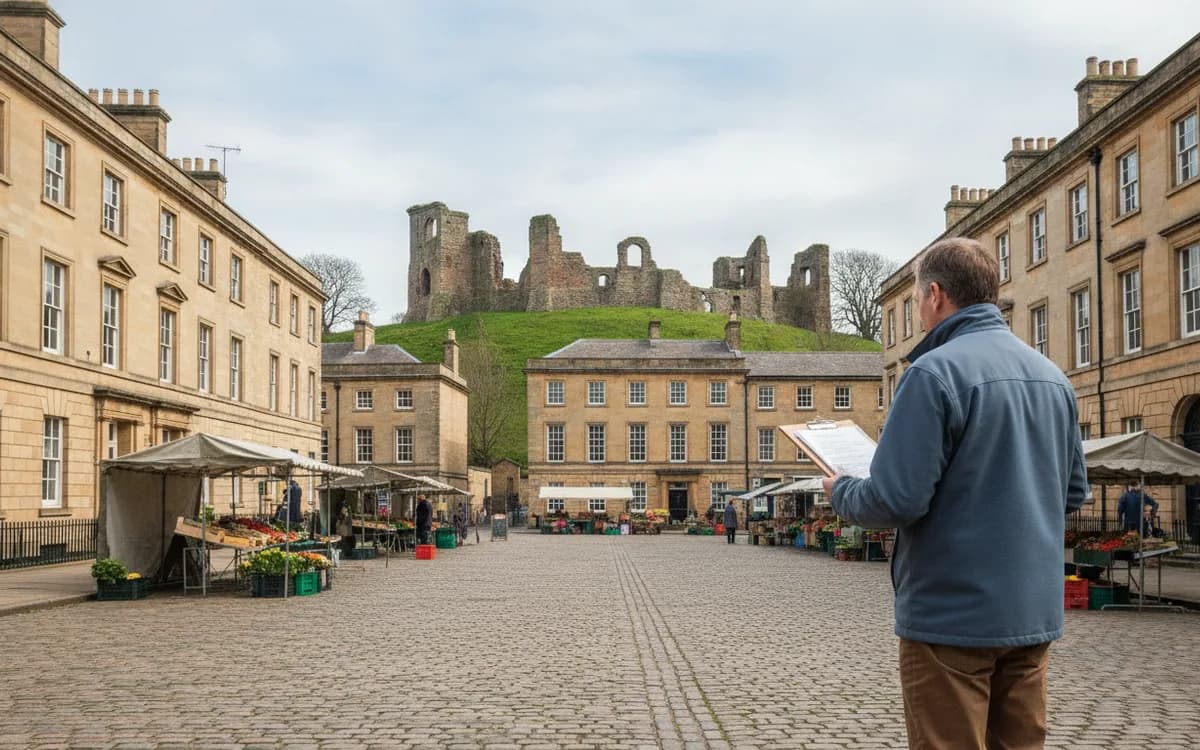
Surveying property in Pontefract
The age and awkwardness of the older stock is why a Level 3 Building Survey is the instruction we recommend most often here. A Georgian house on Micklegate or in the streets behind Beastfair typically has solid walls with no cavity, a roof structure patched by several generations, a cellar cut into the rock, sash windows with original joinery and a rear range added at some point nobody wrote down. A Level 2 Homebuyer Survey is built around a conventional property in reasonable condition and will defer on most of that. A Level 3 examines each element properly, names the cause of what it finds and puts the repairs into an order that makes sense.
Every inspection is carried out personally by a qualified Chartered Surveyor who is fully insured and VRS registered, with over 50 years of combined experience behind the practice. You deal with that surveyor directly rather than through an intermediary, the fee is fixed and confirmed in writing before you commit, and nothing is added to it later. We normally attend within 3 to 5 working days of being instructed and issue the written report within 3 to 5 working days of the visit, and quicker attendance can be arranged when a timetable demands it.
The survey most often needed here
Level 3 Building Survey in Pontefract
A Level 3 Building Survey (formerly the full structural survey) is the most thorough RICS inspection. It suits period homes, listed buildings, timber-framed and non-standard construction, properties that have been extended or altered, and anything in poor condition. The surveyor examines the structure and fabric in detail, explains the likely cause of any defect, sets out repair options and priorities, and discusses the findings with you before and after the inspection.
Suits Buyers of pre-1900 or period property, listed and conservation-area homes, extended or converted houses, non-standard construction, or any property showing signs of movement, damp or neglect.
The Magnesian Limestone ridge, above ground and below it
The Magnesian Limestone forms a narrow band running north out of Nottinghamshire through South and West Yorkshire and on towards the Tees, and Pontefract sits squarely on it. Stone was quarried all along that band, and the best of it was good enough to face buildings of national importance, which tells you something about the material the town was built from. Locally it gives a warm cream and honey coloured stone that looks entirely unlike anything you find west of the Calder.
It also decays in its own particular way. Dolomitic limestone frequently forms a hard outer crust while the stone behind that crust softens, so an elevation can look sound from the pavement while a section of it is ready to come away in the hand. Once water gets past the face, the stone loses its grain and crumbles to powder at the joints, and salts from a cement mortar or a modern render accelerate the process rather than slowing it. The repair is not difficult but it has to be the right one: a lime mortar matched to the stone, cut indents of similar material where a block has failed, and an end to whatever was letting the water in. Where a previous owner has repointed a frontage in cement or painted it with a masonry coating, the report explains what that is doing and what undoing it involves.
Below ground the limestone asks a different question. It is soluble, slowly, in groundwater that is even mildly acidic, and over a very long period that produces solution features: widened joints, cavities, sediment filled pipes running down into the rock and, at the surface, the occasional swallow hole where soil above a void washes into it. Most property in the town stands on perfectly competent rock and has done so without incident for two centuries. The point is that rockhead here is irregular in a way a uniform clay site is not, so foundations on one side of a house can bear on solid limestone while the other side bears on material that has filled an old solution feature, and that is a recipe for slow differential movement.
Three practical consequences follow for a buyer. Concentrated water is the enemy, so a leaking drain, an overflowing gully or a soakaway discharging into fissured rock can quietly enlarge a void beneath a building, and the inspection pays close attention to drainage and to where rainwater actually ends up. Old quarry ground is common around the town and quarries were routinely backfilled with whatever was to hand, so a flat plot can conceal several metres of uncontrolled fill. And where a building shows distortion the fabric cannot explain, a proper ground investigation rather than an educated guess is what settles the matter.
West of the town the ground changes character. The Coal Measures dip away beneath the limestone and the ground under Featherstone, Glasshoughton and the western fringe of Knottingley was mined, with Prince of Wales Colliery working until the early 2000s. For a property on that side, a Coal Authority mining report belongs in the search pack. For a house on the ridge itself, the limestone is the story, and treating the two situations as though they were the same is the mistake we most often have to correct.
What a Level 3 Building Survey covers in a Georgian market town
A Level 3 Building Survey is the most detailed inspection available and the difference from a Level 2 is one of depth rather than tone. The surveyor opens up nothing and lifts no fitted floor coverings, but everything reasonably accessible is examined and described: the roof space and its structure, the covering from ground level and from any safe vantage point, every elevation, the cellar, the visible services, the joinery, the floors, the boundaries and the outbuildings. Each defect is given a stated cause, a view on urgency and an indication of what putting it right involves.
On a Georgian townhouse in the centre of Pontefract that produces a long list of items a shorter inspection would step past. Parapet and valley gutters concealed behind the front elevation are a recurring one. They are usually lead lined, often patched in bitumen and very frequently the source of the damp staining that shows up in the top floor rooms. Chimney stacks on these houses are tall, exposed and commonly redundant, and a flue capped with no ventilation left in it will sweat. Lath and plaster ceilings lose their key and bow. Original sash boxes rot at the cill and the bottom rail before anywhere else. Timber bressummers over inserted Victorian shopfronts carry the entire front wall above them and are almost never looked at by anyone.
The town centre also holds a large stock of upper floors converted into flats and offices over the years, some of it done well and some of it done in an afternoon. Fire separation between a commercial ground floor and the residential floors above is the first thing to establish, then the means of escape, then whether the work ever had building regulation approval. Where a room bridges a passage or a yard entry, which happens repeatedly in a market town built around ginnels and courts, you may be buying a flying freehold, and that needs your solicitor's attention as well as ours because it governs who can compel whom to repair.
Listed buildings need particular care. There are a considerable number in and around the Market Place, and alterations to them require consent whether or not a previous owner troubled to obtain it. An unauthorised replacement window or a removed chimney breast becomes the next owner's liability, so where we see work that looks as though it should have been consented, the report raises it for enquiry before exchange rather than leaving it to surface years later when you come to sell.
Defects we see most in Pontefract homes
Some faults here belong to the building stone and the ground, others to the age of the stock. These recur often enough that we go looking for them by default.
- Face decay and powdering of dolomitic limestone behind a hard weathered crust, worst on elevations pointed in cement or sealed with a masonry coating.
- Damp staining to top floor rooms traced back to lead lined parapet and valley gutters that have been patched with bitumen instead of relined.
- Distortion and cracking on plots that sit partly on solid rock and partly on fill occupying an old quarry or a solution feature.
- Drainage defects that carry more weight than usual, because water escaping into fissured limestone does not simply soak away harmlessly.
- Bowed lath and plaster ceilings, and floor joists split or notched where services have been threaded through the structure of a Georgian house.
- Decayed bressummers and inadequate permanent support above shopfronts inserted into older buildings around the Market Place and Beastfair.
- Flats and offices formed in upper floors with no fire separation from the commercial use beneath and no building regulation paperwork to produce.
- Corroded wall ties and cracked render on inter-war and post-war housing along the Carleton, Ackworth and Darrington roads.
Buying in Pontefract: consents, timing and access
Pontefract draws buyers from further afield than it once did. The A1 and the M62 are minutes away and the stations put Leeds and York within an easy commute, so competition for the better Georgian houses and for family property at Carleton, Ackworth and Darrington is real. Instruct the survey when your offer is accepted rather than when the searches come back, because a Level 3 takes longer on site and longer to write than a Level 2, and it is the report most likely to change what you do next.
Access has to be arranged properly for a Level 3 to be worth what you pay for it. We ask for the loft hatch unlocked and clear of stored belongings, the cellar lit and open, outbuildings and garages unlocked and, in a town centre property, agreement for the surveyor to view the rear from the yard or the passage rather than only from the street. Where the house is tenanted or the seller has already moved out, that takes a few days to organise, so tell us early and we will start it moving.
Much of the historic centre lies within a conservation area, and the practical effect is on what you are free to change: windows, doors, roof coverings, boundary walls and anything else visible from the street. The report records the designation and its consequences. It also records the reverse situation, which arises more often than people expect, where a previous owner has already made a change that needed consent and never applied for it.
If the inspection turns up something needing specialist attention, we take it further ourselves. Suspected ground movement leads to a structural engineer's report, decay at low level to a timber and damp report, and a roof nobody can see properly to a drone survey. You are not handed a list of worries and left to find four different firms, and you can telephone the surveyor who wrote the report and talk it through before deciding anything.
Other surveys and valuations around Pontefract
Besides Level 3 work we carry out Level 2 Homebuyer Surveys on the town's conventional post-war and modern housing, structural engineer's reports where movement is suspected, timber and damp reports, boundary wall dispute reports, drone roof surveys, EPCs and asbestos surveys. On the valuation side we prepare probate valuations, matrimonial valuations, Help to Buy valuations, building insurance valuations for reinstatement cover, and private valuations where somebody simply needs an independent figure they can rely on.
The same coverage extends across this part of the district, so Castleford, Knottingley, Featherstone, Ackworth and Darrington are all served by the same team at the same agreed fee, with nothing added for travel. Commercially we handle building surveys on shops, offices and industrial units, schedules of condition at the start of a lease, dilapidations advice at the end of one, rent reviews and commercial valuations. If you are not sure which report answers your question, describe the property and the problem on the telephone and we will tell you which one fits.
Which level do I need
Level 2 or Level 3 for a Pontefract home?
The decision in four questions
Which survey level does a Pontefract property need?
Read down the left column. If most of your answers sit in the Level 2 column, a Level 2 Homebuyer Survey is usually enough. If two or more sit in the Level 3 column, instruct a Level 3 Building Survey. A valuation on its own only tells you what the property is worth, not what is wrong with it.
| Question | Points to Level 2 | Points to Level 3 |
|---|---|---|
| How old is the property? | Built after about 1900, conventional brick or block construction. | Victorian or older, timber-framed, thatched, listed or in a conservation area. |
| Has it been altered? | Original layout, or a straightforward extension with building control sign-off. | Extended, converted, loft conversion, removed walls, or unknown history of works. |
| What condition does it look in? | Well kept, no obvious cracking, damp or roof problems. | Visible cracking, damp patches, sagging roof, or it has been empty for a while. |
| What do you want from the report? | A clear condition rating on each element and a list of what to check before exchange. | The cause of each defect, repair options, priorities and a discussion with the surveyor. |
Still on the fence? Call 07970 562 963 and describe the property. It takes two minutes and the surveyor will tell you straight which level fits and what it will cost.
Common questions in Pontefract
Survey questions from Pontefract buyers
Why is a Level 3 Building Survey usually the right choice in Pontefract?
Because so much of the town predates the construction the shorter report was designed around. Solid walls without a cavity, a roof structure altered several times, a cellar cut into rock and joinery two centuries old all sit outside what a Level 2 can usefully comment on, and the result would be a report full of recommendations to take further advice. On a 1970s house at Carleton a Level 2 is perfectly proportionate, and we will tell you when that is the case.
What is a swallow hole and should it affect whether I buy in Pontefract?
It is a surface hollow that forms when soil above a cavity in soluble rock washes down into it. On the limestone ridge they are occasional rather than commonplace, and the overwhelming majority of property here has stood for generations without trouble. What matters is managing water: sound drains, gutters that discharge properly and no soakaway feeding straight into open fissures. The survey checks those things specifically.
Is limestone harder to look after than brick?
It is less forgiving of the wrong repair. Dolomitic limestone needs to breathe, so a permeable lime mortar and a bare face keep it stable, while cement pointing, gypsum plasters against the inside face and modern masonry paint all trap moisture and salts and hasten decay. Looked after correctly it lasts for centuries with very little attention. The damage we record is nearly always the result of a well meant repair using the wrong material.
Does a Level 3 Building Survey include a valuation?
Not as standard. The Level 3 is a condition report and its job is to explain the building rather than to price it, so it does not carry a market figure in the way a Level 2 does. Where you need a value as well, we can prepare a separate valuation alongside the survey, and for insurance purposes a building insurance valuation gives the rebuilding cost rather than the market price.
Do I need a coal mining search for a house in Pontefract?
It depends which side of the town it stands on. The ridge the historic core occupies is limestone, but the ground out towards Featherstone, Glasshoughton and the western edge of Knottingley was worked for coal until relatively recently. Your solicitor should check the address against the Coal Authority's own boundaries rather than assume, and the survey will tell you if anything in the fabric points that way.
What is a flying freehold and why does it keep coming up in the town centre?
A flying freehold is part of one property overhanging or underlying another, most often a room built over a shared passage or entry. Pontefract's centre grew around yards and ginnels, so it is far from rare here. It is not a reason to abandon a purchase, but it affects lending and it complicates who is obliged to maintain the structure above and below, so your solicitor needs it flagged early.
How long does a Level 3 Building Survey take on site?
Longer than people anticipate. On an older town centre house the surveyor is usually in the building for several hours, and a large or much altered property can take most of a working day. That time is the point of the exercise. Roof spaces, cellars, every room and every elevation are covered individually, and the written report follows within 3 to 5 working days of the inspection.
The house is listed. Does that change what the survey does?
It changes the emphasis. The inspection still reports on condition, but it also identifies work that appears to have been carried out without the consent it needed, and it considers repair options against what would actually be permitted on a listed structure. Replacing decayed limestone with a cement based mortar or swapping timber sashes for plastic is not simply poor practice on these buildings, it is a consent issue your solicitor has to resolve before exchange.
How much does a Level 3 Building Survey cost in Pontefract?
The fee reflects the size, age, type and value of the building, and we fix it and confirm it in writing before you instruct, so there is no possibility of a charge appearing afterwards. Tell us the address and the asking price and you will have a figure to work with. Nothing is added for travel anywhere in this part of the district.
Can you inspect a flat above a shop in the Market Place?
Yes, and mixed use buildings of that kind need the detailed level. The surveyor inspects the flat, the accessible common parts and the building envelope, and comments on the shared roof and structure you will be contributing towards. The questions that decide whether it is a sensible purchase tend to be fire separation from the commercial floor, the state of the lease, and who is responsible for the front elevation and the shopfront below.
Will the survey tell me about the drains?
It covers what can be inspected visually. The surveyor lifts accessible chamber covers where it is safe and reasonable to do so, looks at the condition of the chambers, and reports on gutters, downpipes and gullies. Surveyors do not carry out drainage tests or camera surveys. On limestone ground, where escaping water can do real harm below the building, we recommend a drainage investigation more readily than we would elsewhere.
Do you cover Castleford, Knottingley and Ackworth as well?
Yes. All of them fall inside the area this office works, along with Featherstone and Darrington, and the quoted fee covers the visit wherever the property sits within it. The building stock changes noticeably across that short distance, from limestone in the old town to brick terraces built for the collieries and estate housing of the last few decades, and the report is written for the property in front of us rather than to a template.
Also covered from Pontefract
We survey Castleford, Knottingley, Featherstone, Ackworth and Darrington from our Pontefract work, at the same fixed fee. Travel is included, so the figure does not change because the property sits on the edge of the patch.
Book your survey
Book a survey in Pontefract
Postcode, survey type and a phone number. The surveyor will come back with a fixed fee for the Pontefract property and the earliest date.
Prefer to talk it through first?
Call 07970 562 963