
Commercial Building Survey, Leeds, West Yorkshire
Commercial Building Survey in Leeds
The person commissioning a commercial survey is usually not the person who will live with the building, and that changes everything about how the report is written. An investor wants to know what the asset will cost to hold and whether the income is secure. An occupier wants to know whether the unit will do the job and what the landlord will make them pay for. A tenant taking a full repairing and insuring lease wants to know, above all else, what condition they are about to become contractually responsible for. Those are three different reports from one inspection, and the scope gets agreed with you before the surveyor attends rather than assumed.
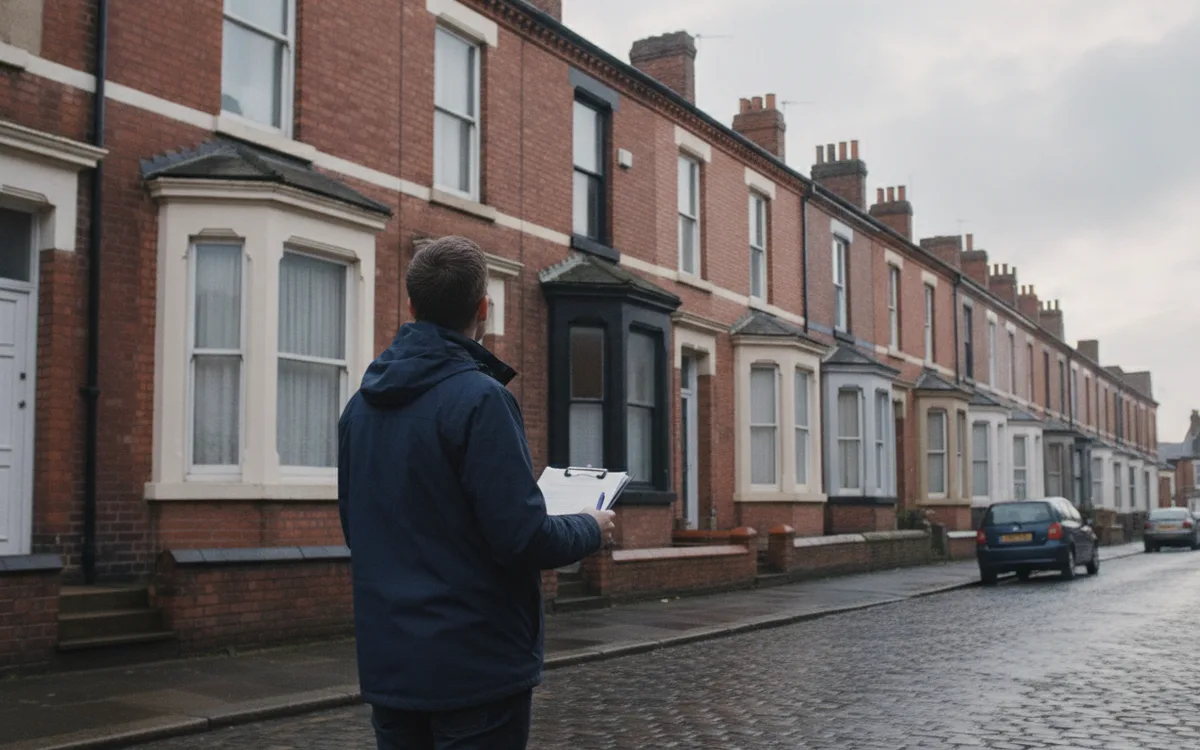
A commercial building survey in Leeds reports on the structure, fabric, roof and services of a shop, office, industrial unit or mixed-use building before you buy it or take a lease. It quantifies repair liability, flags statutory and compliance risk, and gives you evidence to negotiate price or lease terms.
Why Leeds buyers instruct a commercial building survey
There is no standard format and no traffic light system here. Commercial surveying does not have the fixed levels that residential work has, so the value of the exercise depends on the brief being set properly: which buildings, which parts, what depth, whether plant and services are to be covered by specialist consultants, whether you want a costed schedule of repair over a defined horizon, and what the transaction timetable allows. A survey written for a purchaser without knowing the lease terms is a description of a building rather than an assessment of a liability.
Leeds gives you an unusually wide range of commercial property in a small geographical area: the new-build office core around Wellington Place and Whitehall Road, the Victorian and Edwardian commercial buildings on Park Row, East Parade and around the arcades, converted mills and foundries at Holbeck, Hunslet, Armley and along the Kirkstall Road corridor, sheds and trade counters at Cross Green, Stourton, Gelderd Road and Seacroft, out of town office parks at Thorpe Park and Leeds Valley Park, and suburban retail parades through Headingley, Chapel Allerton, Horsforth and Garforth. Each of those carries a different risk profile, and the surveyor who inspects them has to know which one they are standing in.
What the survey covers
What a commercial building survey includes
A commercial building survey reports on the condition of the structure, fabric, roof and services of a commercial property before you buy it or take on a lease. It identifies defects, estimates repair liabilities, flags compliance issues and gives you the information to negotiate the price, the lease terms or the repairing obligations.
Suits Business owners, investors and tenants acquiring or leasing commercial premises.
A different client, a different brief
The first conversation is about what you are trying to decide, not about the building. A purchaser of a multi-let office wants the report structured around capital expenditure over the holding period, because that is what will be argued about in the price. An owner-occupier buying a unit at Stourton wants to know whether the roof and the floor slab will take what the business does to them. A tenant taking twenty years on a parade shop wants the condition of the parts nobody mentions during the viewing: the flat roof over the rear store, the drainage in the service yard, the plant on the roof and the state of the shopfront above the fascia. The inspection is the same walk round the building; the report is not.
Because the client is commercial, so is the language. The report quantifies. Where a residential survey would say that a covering is nearing the end of its life, a commercial survey says how much of it, over what area, on what timescale, and whether it is a repair, a partial overlay or a full replacement, so the number can be put into an acquisition model or set against a rent free period. Where a defect is the landlord's under the lease and not yours, the report says so, because a liability that sits with somebody else is not a liability you should be pricing.
There is also a limit worth stating early. A building survey is not the whole of due diligence. It does not cover title, planning history, the accuracy of the tenancy schedule, contamination testing, or the valuation of the asset. It sits alongside the legal enquiries, the environmental report, any measured survey and, where required, a Red Book valuation, and it is at its most useful when all of those are read together rather than in isolation.
Lease context: schedules of condition and dilapidations
Most commercial property in Leeds is let on terms that put repair onto the tenant, and an unqualified full repairing and insuring lease is a considerably bigger commitment than most incoming tenants realise. The obligation is normally to keep the premises in repair, and the courts have long held that you can be required to hand back a building in better condition than you received it. A tenant taking a fifteen year old industrial unit with a tired roof and a patched service yard, on a lease with no limit on the repairing covenant, has just taken on the cost of putting all of it right.
The remedy is a schedule of condition, agreed and attached to the lease before it is completed. It is a dated written and photographic record of the exact state of the premises at the start of the term, and where the lease is properly drafted to refer to it, the repairing obligation is limited to that recorded condition. It has to be done before completion, it has to be detailed enough to be useful three or fifteen years later, and the wording of the lease has to tie back to it. A schedule of condition prepared after the lease is signed protects nobody, which is why we ask about the timetable as the first question.
At the other end of the term comes the schedule of dilapidations, where the landlord claims the cost of putting the premises back into the condition the lease requires. These claims are routinely overstated, and they are routinely capped in ways that surprise the landlord, because the damages recoverable are limited by reference to the effect on the value of the landlord's interest. We prepare schedules for landlords who want a defensible claim and challenge them for tenants who have been served one, and in both cases the argument turns on the lease wording, the evidence of condition, and what the landlord actually intends to do with the building afterwards.
- Full repairing and insuring lease with no schedule of condition: the tenant's repairing obligation is effectively open ended.
- Schedule of condition agreed before completion and referred to in the lease: liability is limited to the state recorded on the day.
- Interim schedule served during the term: the landlord is seeking repairs now rather than money at the end.
- Terminal schedule served at or near expiry: negotiation on scope, cost and the landlord's intentions for the building.
- Service charge in a multi-let building: the repairs you do not carry out directly still reach you through the annual account.
- Break clauses conditional on full compliance with repairing covenants, which is where an unexpected dilapidations position can cost a tenant the break entirely.
- Rent review evidence, where the condition of the premises and the terms of the lease both bear on the reviewed figure.
- Landlord works and reinstatement obligations at expiry, including removing the tenant's own alterations back to an agreed base specification.
The risks that decide a commercial deal in Leeds
Commercial buildings fail in ways residential buildings do not, and most of the money in a commercial survey sits in the roof, the services and the statutory position rather than in the walls. These are the issues that recur across the Leeds stock and that most often move a price or a lease term.
- Reinforced autoclaved aerated concrete planks in flat roofs and floors of buildings put up between the 1950s and the mid 1990s, which have a limited design life and need identifying, recording and assessing rather than assuming.
- Cut edge corrosion and failed fixings on profiled metal sheeting across the industrial estates at Cross Green, Stourton, Gelderd Road and Seacroft, where the sheet itself may be sound and the laps and gutters are not.
- Single ply and asphalt flat roofs on 1970s and 1980s offices, where the falls are inadequate, the outlets are blocked and the insulation beneath is saturated without anything showing inside.
- Northlight and valley gutter roofs on converted mills at Holbeck, Hunslet and Armley, where the gutters are internal, the overflow route is into the building, and access for maintenance was never properly designed.
- Asbestos in the services and later fabric of anything predating 2000, with an absent or out of date register transferring a live legal duty to the incoming owner or occupier.
- Energy performance and the minimum standard required before premises can be let, which on older Leeds offices and shops can mean substantial expenditure before the building is capable of producing income at all.
- Fire compartmentation breached by later service runs, missing cavity barriers above suspended ceilings, and means of escape compromised by subdivision of floors into smaller suites.
- Made ground, historic contamination and flood exposure on former industrial land along the Aire corridor, from the Kirkstall Road frontages through to Knostrop and Stourton.
How the inspection is carried out and what the report contains
The surveyor inspects the structure, the external envelope, the roofs, the internal finishes, the common parts, the external areas and the services on view. Roof access is arranged in advance and, where it cannot be made safe, a drone is used rather than a set of assumptions. Plant rooms, risers, roof voids and sub-floor areas are entered where access allows. On a purchase the vendor will sometimes permit limited opening up, and where they do, that is often the single most valuable hour of the whole exercise. Statutory and maintenance records are requested as part of the instruction: electrical condition reports, gas and heating certification, lift inspection records, water hygiene risk assessments, fire risk assessments, the asbestos register and any warranty documentation for recent roof works.
Mechanical and electrical plant is reported on visually by the building surveyor, and that limit is stated plainly rather than glossed over. Where a building has significant plant, air conditioning, a lift, a sprinkler installation, a substantial three phase distribution system or process equipment, a specialist services engineer should inspect and test it as part of the same due diligence. On an investment purchase that specialist input is usually the difference between a report that reads well and a report that protects the money.
The written document runs to an executive summary that can be read by somebody deciding whether to proceed, a description of the construction, a section by section account of condition with photographs, and a schedule of the matters that carry cost. Where you have asked for one, the costed schedule sets out budget allowances for immediate work, work within the next five years, and work within ten, which is the format that drops straight into an acquisition appraisal or a service charge forecast. There is a separate section of matters for your solicitor, covering rights of access, shared service media, boundary responsibility, statutory compliance gaps and anything the lease or title needs to resolve.
Instructing a commercial building survey in Leeds
Come to us with the heads of terms or the draft lease if there is one, because the report should be written against the obligations you are actually taking on. Tell us the transaction date, whether the building is occupied, who holds the keys and whether roof access is available, since those four answers set the programme. For a multi-let building we also need the tenancy schedule, because whether a defect is yours, a tenant's or recoverable through the service charge is a question about the leases rather than about the brickwork.
We attend within 3 to 5 working days of instruction and report within 3 to 5 working days of the inspection, and where a deal is moving faster than that we will say honestly what can be delivered in the time rather than promising a date we cannot hold. The fee is fixed and agreed in writing against a defined scope. If the scope changes, because a second building is added or the vendor agrees to opening up, we requote rather than adding to the invoice afterwards.
The survey rarely travels alone. Alongside it we prepare schedules of condition for tenants signing leases across the city, dilapidations schedules and negotiations for landlords and tenants at expiry, commercial valuations to Red Book standards for purchase, lending, pension and accounting purposes, rent review advice and negotiation, fire risk assessments for the responsible person, and asbestos surveys where the register is missing or out of date. Where you need several of those, they are more useful commissioned together, because the same surveyor sees the building once and the reports do not contradict each other.
Why instruct us
What Leeds buyers get from us
The surveyor who inspects is the surveyor you speak to
Personal, one to one communication with the surveyor and no third parties involved. You can talk through concerns before the visit and the findings afterwards.
Fixed fees, no hidden charges
The fee quoted is the full fee. Every survey is undertaken by a qualified Chartered Surveyor, fully insured and VRS registered.
Attend in 3 to 5 working days, report in 3 to 5 working days
The average repair bill for new home owners is £5,750, which is exactly what a survey is designed to catch before you exchange. On request the surveyor can attend and report within 24 hours.
Commercial Survey questions in Leeds
Commercial Building Survey questions from Leeds buyers
How does a commercial building survey differ from a residential one?
There are no fixed levels and no condition ratings, so the scope is agreed with you in advance and written around the decision you are making. The emphasis shifts to repair liability, plant and services, statutory compliance and the lease, and the findings are quantified so they can be priced into a deal rather than simply described.
I am taking a full repairing and insuring lease. What should I instruct?
A building survey and a schedule of condition, and both before the lease completes. The survey tells you what you are taking on and what it will cost across the term. The schedule records the condition of the premises on the day so that, provided the lease is drafted to refer to it, your repairing obligation is limited to that state rather than to putting the building right generally.
What is a schedule of condition and when must it be agreed?
It is a dated written and photographic record of the exact state of the premises at the start of a lease, prepared in enough detail to be relied on years later. It has to be agreed before completion and expressly referred to in the lease. Prepared after signature it carries no contractual weight, which is the single most common and most expensive mistake incoming tenants make.
Can you inspect the lifts, air conditioning and other plant?
We report on plant and services visually and review whatever inspection and maintenance records exist, and we state that limit clearly. Testing lifts, air conditioning, sprinkler systems and substantial electrical distribution is specialist work, and on any building where the plant carries real value we recommend a services engineer inspects and tests as part of the same due diligence exercise.
Does the survey cover energy performance and the minimum letting standard?
The report flags the position and what it means commercially, because a building that cannot lawfully be let until it is improved is not producing income whatever else is right with it. On older Leeds offices, shops and converted buildings the works needed to reach the standard can be substantial, and those costs belong in the acquisition appraisal rather than in a surprise the following year.
Will the report tell me what repairs will cost over the next ten years?
It will if you ask for a costed schedule, and most purchasers and tenants should. Budget allowances are set out for immediate work, work within five years and work within ten, so the figures can be dropped into an acquisition model or a service charge forecast. They are budget estimates for planning, not tendered prices, and the report says so.
What is RAAC and should I worry about it in a Leeds building?
Reinforced autoclaved aerated concrete is a lightweight precast material used in roof and floor planks from the 1950s to the mid 1990s. It has a limited design life and can fail with little visible warning, so where the construction and age suggest it may be present the surveyor looks for it specifically, records what is found, and recommends a structural assessment rather than leaving the question open.
Do you survey mill and warehouse conversions in Leeds?
Regularly. They bring a distinct set of issues: cast iron columns and jack arch floors with limited load capacity for modern use, internal valley and northlight gutters that discharge into the building when they block, wide roof areas with no safe maintenance access, later services threaded through historic fabric, and heritage constraints on what can be altered. They reward a surveyor who has been in them before.
I have been served a schedule of dilapidations. Can you help?
Yes. Claims served at lease end are frequently overstated and frequently capped in ways landlords do not expect, because damages are limited by reference to the effect on the value of the landlord's interest. We review the lease, inspect the premises, test each item against the covenant and the evidence, and negotiate the settlement. We act for landlords preparing claims as well, though never for both sides of the same one.
Is a commercial building survey the same as a valuation?
No, and they answer opposite questions. The survey is about physical condition, liability and cost. A valuation is a formal opinion of market or rental value prepared to Red Book standards for a stated purpose such as lending, pension acquisition, accounts or tax. Many clients need both, and commissioning them together means one inspection and two documents that agree with each other.
How long does a commercial building survey take?
The inspection depends entirely on the building. A single suburban shop unit in Headingley or Horsforth might take half a day. A multi-let office floor plate in the city centre, or an industrial estate of several units at Cross Green, runs into several days on site. We attend within 3 to 5 working days of instruction and report within 3 to 5 working days of completing the inspection.
Does the survey look at fire compartmentation and means of escape?
It reports on what can be seen and identifies the obvious failures: compartment walls breached by later cabling and ductwork, missing barriers above suspended ceilings, escape routes compromised where floors have been subdivided into smaller suites, and doors that will not perform. A formal fire risk assessment is a separate instruction and a legal requirement for the responsible person, and we carry those out too.
Book your survey
Book a commercial building survey in Leeds
A fixed fee and the earliest available date, from the surveyor who will carry out the inspection.
Prefer to talk it through first?
Call 07970 562 963